
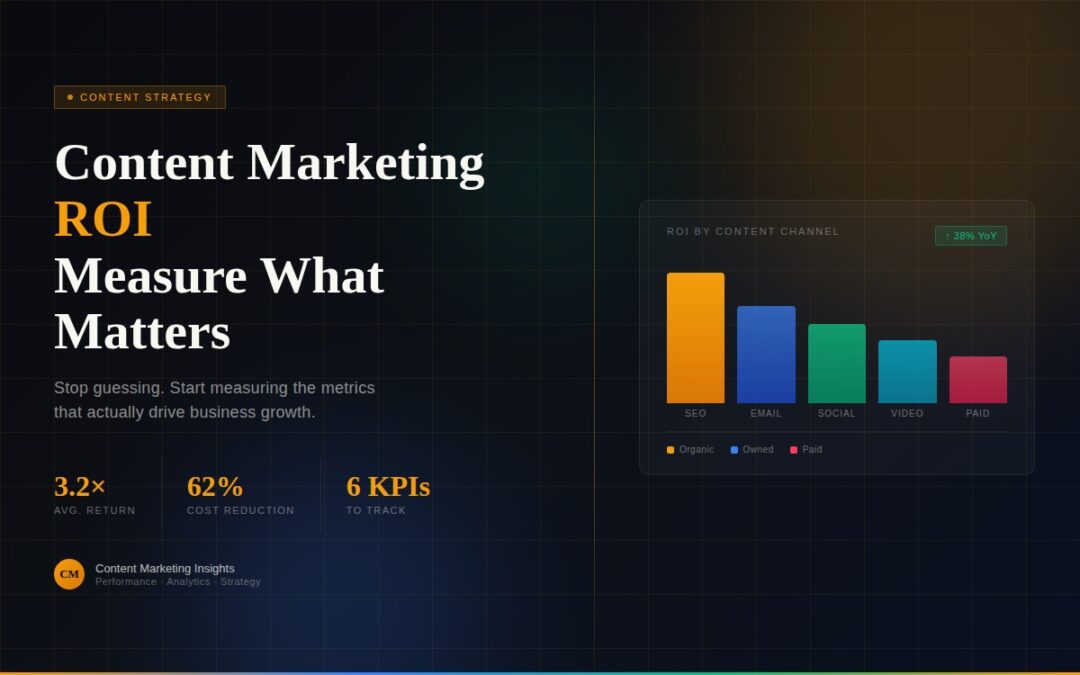
Content Marketing ROI: How to Measure What Matters
You’ve been publishing blog posts, shooting videos, sending newsletters. Your team is working hard. But when the CFO walks in and asks, “What’s the return on our content investment?” — you freeze.
You’re not alone. According to Content Marketing Institute, only 43% of B2B marketers say they’re able to clearly demonstrate content marketing ROI. The rest are flying blind — spending budgets they can’t justify, running campaigns they can’t optimize.
At Marketing Baba, we believe every rupee or dollar you put into content should be traceable. This guide is the definitive playbook for measuring content marketing ROI — from the basic formula to advanced attribution models — so you can finally prove (and improve) your content’s real business impact.
What Is Content Marketing ROI (and Why Most Get It Wrong)
Content Marketing ROI is the measurement of revenue or business value generated from your content efforts relative to what you spent creating and distributing it. Simple in theory. Maddeningly complex in practice.
The reason most marketers struggle? They confuse activity metrics (how much content they published) with impact metrics (what that content actually produced). Publishing 50 blog posts is an activity. Those 50 posts generating 2,000 qualified leads worth ₹40 lakhs in pipeline — that’s ROI.
There’s also the time lag problem. A blog post you publish today might generate its peak traffic 6 months from now when it finally earns enough backlinks to rank on page one. Traditional ROI calculations miss this entirely — and it makes content look far less effective than it actually is.
The ROI Formula — Simplified
Let’s start with the foundation. The basic content marketing ROI formula is:
ROI = ((Revenue from Content − Cost of Content) ÷ Cost of Content) × 100
This gives you a percentage. An ROI of 200% means for every ₹1 you spent, you got ₹3 back (your original ₹1 plus ₹2 profit).
Calculating your content costs requires honesty. Your true cost includes writer or creator fees (in-house salary or freelancer rates), designer and editor time, SEO tool subscriptions, your content management platform, paid promotion spend, and project management overhead — including your own time coordinating everything.
Calculating revenue from content is trickier. Common approaches include tracking UTM-tagged content that leads directly to purchases, using CRM data to link contacts to their first or last content touchpoint, and measuring pipeline value that content influenced during the sales process.
For businesses with long sales cycles, Marketing Baba recommends measuring “pipeline influenced” rather than just closed revenue. A blog post that educated a lead who converted six months later still deserves credit — and pipeline attribution captures that.
The Metrics That Actually Matter
Not all metrics are created equal. Here’s how to separate signal from noise.
Traffic and Awareness Metrics tell you whether your content is reaching the right people. Organic sessions is the most important here — it’s SEO-driven traffic that compounds over time. New vs. returning users tells you whether you’re growing your audience (new) or building loyalty (returning). Page views alone are largely vanity — only meaningful when paired with engagement data.
Engagement Metrics tell you whether people are actually consuming your content. Scroll depth is underused and incredibly revealing — a 70%+ scroll rate means readers are genuinely engaged. Time on page matters too; a 3+ minute average on a long-form guide signals real content consumption. Comments and shares are harder to fake than clicks, making them strong quality signals.
Conversion Metrics are where ROI lives. Lead generation rate (the percentage of readers who take an action like filling a form or downloading a resource) is critical. Content-assisted revenue, tracked through your CRM, shows sales where content played a role in the buyer’s journey. Cost Per Lead from content, compared against your paid channel CPLs, is often where content teams win the budget argument — content-generated leads typically cost 60–80% less than paid leads over a 12-month horizon.
SEO and Authority Metrics capture the compounding long-term value of content. Domain Rating or Domain Authority growing over time signals that your content is earning backlinks and building trust. The number of keywords ranking on page one compounds — one well-written pillar post can rank for dozens of related terms. Backlinks earned organically are the strongest indicator that your content has genuine industry authority.
Mapping Metrics to Your Funnel Stage
Different content serves different stages of the buyer journey. Measuring a top-of-funnel awareness blog post by sales closed is like judging a first date by whether you got married. Match your expectations and metrics to intent.
Top of Funnel (Awareness): Your content here — educational blogs, social posts, YouTube videos — should be measured by organic traffic, impressions, social reach, and new visitor counts. Success means more people discover you exist.
Middle of Funnel (Consideration): Case studies, comparison guides, webinars, and email sequences live here. Measure email sign-ups, content downloads, webinar registrations, return visits, and scroll depth. Success means interested people are moving closer to a decision.
Bottom of Funnel (Decision): Product pages, demo videos, testimonial content, and ROI calculators sit here. Measure demo requests, free trial sign-ups, sales page conversion rate, and cost per lead. Success means prospects are taking commercial action.
Post-Purchase (Retention and Advocacy): Onboarding content, tutorials, and community-building content reduce churn and create referrals. Measure NPS scores, upsell rates, and referral traffic. This stage is chronically underinvested — and it’s often the highest-ROI content a brand can create.
Most marketers only track the bottom funnel. The brands that dominate their niche track all four stages, because they understand that a reader who spends 8 minutes on an awareness post today is likely to convert 90 days from now.
Attribution: Giving Content Its Proper Credit
Attribution is where most content ROI discussions break down. A customer may have read your blog, seen a retargeting ad, opened three emails, and watched a webinar before buying. Which touchpoint gets the credit?
First-touch attribution gives 100% of credit to the first content piece a user ever interacted with. This is best for measuring what drives discovery and awareness, but it severely undervalues nurturing content.
Last-touch attribution gives 100% of credit to the final touchpoint before conversion. It’s easy to set up in GA4 but overvalues bottom-funnel content and makes top-of-funnel content look useless — which is why many content teams lose budget arguments despite doing excellent work.
Linear attribution splits credit equally across every touchpoint in the journey. More balanced, but it doesn’t reflect real differences in how much each touchpoint actually influenced the decision.
Data-driven attribution is the gold standard. GA4 and advanced CRM tools now offer machine-learning-based models that assign credit based on actual conversion patterns in your specific data. It’s increasingly accessible even for mid-sized businesses and is the model Marketing Baba recommends for optimization decisions.
A practical approach: use data-driven attribution when optimizing your content strategy (it shows you what’s truly working), but use linear attribution when reporting to stakeholders who want to see every content piece contributing something. It’s easier to explain and less likely to trigger “why are we spending on awareness content?” conversations.
Best Tools to Measure Content Marketing ROI
You don’t need an expensive enterprise stack to measure ROI effectively.
Google Analytics 4 is the non-negotiable starting point. It tracks traffic, user journeys, conversions, and offers data-driven attribution — all free. If you haven’t migrated fully and configured your conversion events, do that before anything else.
Google Search Console is free and shows you exactly which keywords drive clicks, your average ranking positions, and which pages get the most impressions. Pair it with GA4 for a complete picture of your organic content performance.
Ahrefs or SEMrush are the paid tools worth investing in once you’re serious about content. They track backlinks, domain authority, keyword ranking changes over time, and competitor content gaps. Even the entry-level plans give content teams enormous insight.
HubSpot CRM (free tier) is essential for B2B businesses. It connects your content touchpoints to actual contacts in your pipeline, letting you see which blog posts or downloads influenced specific deals. The “content-assisted revenue” view alone justifies the setup time.
Hotjar or Microsoft Clarity (both free) give you heatmaps, scroll maps, and session recordings. When a blog post has high traffic but low conversion, these tools show you exactly where readers are dropping off and why.
Looker Studio (free, by Google) lets you pull GA4, Search Console, and CRM data into a single dashboard. Build a simple content ROI view once, share it with your team, and update it automatically every month.
Marketing Baba’s starter stack recommendation: GA4 + Search Console + Hotjar + HubSpot free CRM + Looker Studio. Zero rupees, covers 80% of what you need, and takes about a day to set up properly.
Marketing Baba’s 5-Step Content ROI Framework
Here’s the process we use with clients, reviewed every quarter.
Step 1 — Define your business goal first. Before creating content, decide what it needs to accomplish. More leads? Lower customer acquisition cost? SEO traffic? Brand authority? Each goal needs different metrics. Defining this upfront prevents the “we got traffic but not sales” conversations that destroy content team credibility.
Step 2 — Set a measurement baseline. You can’t measure improvement without a starting point. Before launching any campaign, document your current organic traffic, lead volume, cost per lead, and keyword rankings. This becomes your “before” number.
Step 3 — Tag everything with UTMs. Every piece of content distributed via email, social, or paid promotion needs UTM parameters. Without them, GA4 misattributes traffic and you’ll never know which distribution channel works best. Use Google’s Campaign URL Builder to generate these consistently across your team.
Step 4 — Build a simple ROI dashboard. Connect GA4 to Looker Studio. Pull in your top content pieces by sessions, conversion rate, and goal completions. Add a content cost column from your project tracker. Now you have ROI visibility at a glance — and you can update it monthly in under 20 minutes.
Step 5 — Run a quarterly content audit and shift investment. Every three months, review your content portfolio. Identify the top 20% of performing pieces: update them, build supporting cluster content around them, and proactively earn links to them. Identify the bottom 20% — pieces with traffic but no conversions — and either optimize them with stronger CTAs or consolidate them into higher-performing pages.
Marketing Baba clients who implement this framework typically see a 35–60% improvement in content-driven lead volume within two quarters — not from creating more content, but from measuring and optimizing what they already have.
Common Mistakes to Avoid
Measuring too early is the most common mistake. SEO content needs 3 to 6 months to mature. Judging ROI at 30 days makes legitimate content strategies look like failures.
Only counting direct conversions misses most of content’s value. Use CRM pipeline data to capture influenced revenue, not just last-click GA4 conversions.
Ignoring content costs artificially inflates ROI. Many teams track content revenue but forget to include editor time, design hours, and tool subscriptions in their cost calculations.
Treating all content equally distorts your analysis. A 3,000-word pillar guide and a social caption are not the same investment — track ROI by content type separately.
Not setting up goal tracking in GA4 is surprisingly common. If conversion events aren’t configured, you’re only seeing traffic, not value. Set up goals before you publish, not after.
Publishing without a distribution plan is the fastest way to kill content ROI. Great content with no promotion has no audience, and no audience means no return. Distribution cost must be factored into your investment from day one.
Comparing content to paid ads on a 30-day basis is an unfair fight. Paid ads deliver immediately; content compounds over time. Always compare them over a 12-month window, not monthly snapshots.
Final Word: Measure to Earn the Right to Grow
Content marketing without measurement is an act of faith. Content marketing with measurement is a business strategy.
The difference between brands that keep cutting their content budget and brands that keep doubling it is simple: the second group knows their numbers. They can walk into any boardroom and say, “Our content generated X leads at Y cost per lead, influenced Z in pipeline, and our organic traffic compounded 40% year over year.” That’s a budget conversation that ends with more resources, not less.
Start simple. Set up GA4 goals. Tag your content with UTMs. Pick three core metrics that connect to revenue. Review them monthly. You don’t need a perfect attribution model on day one — you need enough data to make better decisions than you made last quarter.
At Marketing Baba, we’ve helped dozens of businesses transform their content from a cost center into their most efficient lead generation channel. It always starts the same way — with someone finally deciding to measure what they already have.
Your content is working harder than you know. It just needs you to start paying attention.
-
Digital Marketing in 2026: What’s Working, What’s Dead, and What’s Next: Read More
-
9 Ultimate Lead Generation Secrets Revealed: Read More
-
8 Fresh Content Ideas to Engage Your Audience: Read More