Zero-Click Searches: How to Win Traffic When Google Answers Before They Click
You type a question into Google. The answer appears right at the top of the page — no clicking required. You got what you needed. Google is happy. But the website that actually provided that answer? They got nothing. No visit. No session. No conversion opportunity.
Welcome to the world of zero-click searches. And if you’re running a website, a blog, or a business that depends on organic traffic, this is one of the most important shifts in search you need to understand right now.
At Marketing Baba, we don’t believe in panic. We believe in strategy. So let’s break down exactly what zero-click searches are, why they’re growing, and — most importantly — how smart marketers are winning even when Google answers before anyone clicks.
What Are Zero-Click Searches?
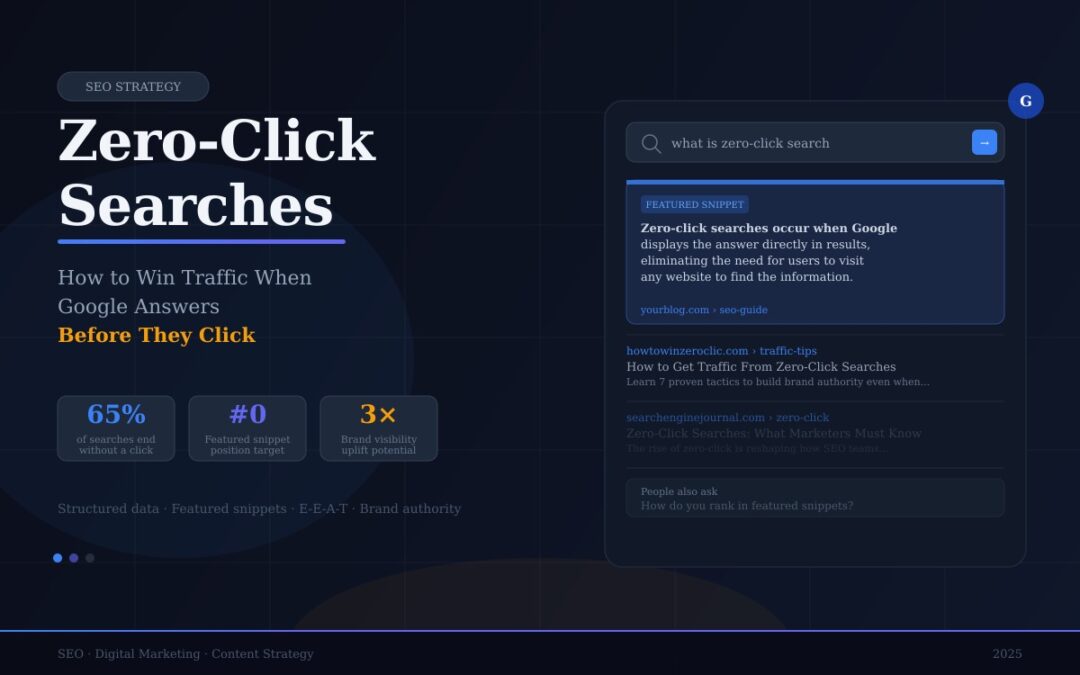
A zero-click search is any search query where the user gets their answer directly on the Google results page without clicking through to any website. Google displays the information — pulled from a webpage, a database, or its own knowledge systems — and the user leaves satisfied without ever visiting the source.
You’ve seen these everywhere. Type “what is the capital of France” and Paris appears instantly in a knowledge panel. Search “currency converter INR to USD” and a live calculator shows up. Ask “how many calories in a banana” and Google answers before you even think about scrolling.
These are zero-click results. And they’re not a glitch or an accident — they’re a deliberate feature that Google has been aggressively expanding for years.
According to research by SparkToro and Datos, more than 58% of Google searches in the US now end without a single click. In mobile searches, that number is even higher. The landscape of search has fundamentally changed, and marketers who don’t adapt are quietly losing ground every single day.
Why Is Google Doing This?
Understanding the motive helps you understand the mechanism.
Google’s stated mission is to organise the world’s information and make it universally accessible and useful. From Google’s perspective, answering a question instantly inside the search results page is the perfect fulfilment of that mission. The user gets the answer in two seconds. Google looks brilliant. Everyone wins — except the publisher.
Google also has a business incentive. The longer users stay on Google’s properties — Search, Maps, YouTube, Shopping — the more ad revenue Google generates. Zero-click features like featured snippets, knowledge panels, People Also Ask boxes, and AI Overviews keep users inside Google’s ecosystem. Every zero-click result is, in a sense, Google competing with the websites it indexes.
This isn’t a conspiracy theory. It’s a business model. And once you accept that, you can start building a strategy around it rather than fighting it.
The Different Types of Zero-Click Features
Not all zero-click results are the same. Knowing which types exist helps you figure out which ones to target and which to work around.
Featured Snippets are the boxed answers that appear at the very top of search results — sometimes called “position zero.” Google pulls a paragraph, list, or table from a webpage and displays it directly. The source URL is credited, but the full answer is already visible. Users often don’t need to click.
Knowledge Panels appear on the right side of the results page for brands, people, places, and well-known entities. They pull data from Google’s Knowledge Graph — a massive database of facts. If someone searches your brand name, your knowledge panel is what they see first.
People Also Ask (PAA) boxes are the expandable question dropdowns that appear mid-page. Each question expands to show a short answer pulled from a website. PAA boxes are powerful because they compound — clicking one question generates more related questions, keeping users engaged within Google.
Local Packs show maps and business listings for location-based searches. Search “digital marketing agency in Ahmedabad” and a map with three listings appears before any organic results. Users can call, get directions, or visit a website directly from the pack — but many never scroll past it.
AI Overviews are Google’s newest and most aggressive zero-click feature. Powered by generative AI, these summaries appear at the very top of results and synthesise information from multiple sources into one comprehensive answer. As of 2026, AI Overviews are appearing on a rapidly growing percentage of informational queries and represent the biggest challenge — and opportunity — for content marketers.
Calculator and Converter Tools handle maths, currency, time zones, unit conversions, and more directly in Google. No website can compete with these for pure transactional convenience. The smart move is to not target these queries at all.
The Real Impact on Your Traffic
Here’s where marketers need to be honest with themselves. Zero-click searches do reduce click-through rates on certain types of queries — particularly informational ones with simple, factual answers.
If you’ve built your entire SEO strategy around ranking for “what is digital marketing” or “how many followers does Instagram have,” you’re targeting queries that Google has essentially claimed for itself. The click-through rates on these terms have dropped dramatically, and they’ll continue to drop as AI Overviews expand.
But here’s what the data also shows: not all searches go zero-click. Complex queries, commercial intent searches, comparison queries, and navigational searches still drive enormous click volume. Users searching “best email marketing tool for small business” or “Marketing Baba blog” or “how to set up Google Ads campaign step by step” are not getting a one-line Google answer. They need depth, context, comparison, and trust — and they click through to find it.
The lesson is not that SEO is dead. The lesson is that the type of content you optimise for needs to evolve.
How to Win in a Zero-Click World
Here’s the part Marketing Baba actually cares about — the actionable strategy. There are five approaches that work right now, and smart brands are using all of them.
1. Target Featured Snippets Deliberately
Featured snippets feel like a zero-click loss, but they’re actually a brand awareness goldmine. When your content appears in position zero — even if the user doesn’t click — they see your brand name, your URL, and your expertise. That creates recall. The next time they need deeper information or are ready to buy, they remember you.
To win featured snippets, structure your content to answer questions directly and concisely. Use clear question-based headings (H2 or H3) like “What is content repurposing?” followed immediately by a 40–60 word direct answer. Use numbered lists for process-based queries and comparison tables for versus queries. Google is looking for the clearest, most structured answer — give it exactly that.
2. Go After Queries With Commercial and Transactional Intent
Zero-click results dominate informational searches. They have far less presence on commercial and transactional queries. When someone searches “buy email marketing software,” “best SEO agency in Mumbai,” or “Marketing Baba pricing,” they’re not looking for a box answer. They’re looking for a website to visit, evaluate, and act on.
Shift your keyword strategy toward intent-driven queries. Focus on “best,” “vs,” “review,” “how to choose,” “for small business,” and location-based modifiers. These terms drive clicks because Google cannot answer them with a snippet — the user needs to explore, compare, and decide.
3. Optimise Your Brand’s Knowledge Panel
Your Google Knowledge Panel is prime real estate that most businesses completely ignore. When someone searches your brand name — one of the highest-intent searches possible — your knowledge panel is the first thing they see. Make sure it’s working for you.
Claim and verify your Google Business Profile. Ensure your website has clear structured data markup (Schema.org) for your organisation, including your name, logo, social profiles, and contact information. Build your brand presence on authoritative platforms — Wikipedia if applicable, LinkedIn, Crunchbase, and industry directories — because Google uses these to populate knowledge panels.
A well-optimised knowledge panel builds instant credibility and can drive direct actions like calls, website visits, and direction requests without the user ever scrolling to your organic listing.
4. Build Content That Earns Clicks Through Depth and Curiosity
Google’s snippets can answer “what.” They can rarely answer “how” at the depth a practitioner needs, or “why” in a way that builds genuine understanding, or “which one is right for me” in the context of a specific business situation.
This is your content opportunity. Write posts that go beyond surface-level answers. Use real examples, original data, case studies, frameworks, and opinions. A featured snippet might show someone your three-step framework — but to understand how to actually apply it, they need to click.
The best SEO content in 2026 is not the content that ranks. It’s the content that ranks and earns the click. That requires a compelling meta description that promises value beyond what the snippet shows, a headline that creates genuine curiosity, and content that delivers on that promise every single time.
5. Double Down on Brand Search and Direct Traffic
Here’s the uncomfortable truth that zero-click search has made undeniable: organic search traffic alone is not a sustainable foundation for a modern content brand. You need traffic channels you own and control.
Email newsletters are the most powerful. When someone subscribes to the Marketing Baba newsletter, Google’s algorithm is irrelevant. You have a direct line to that reader. Build your list aggressively. Offer lead magnets. Create newsletter content that is genuinely better than your blog posts — exclusive insights, early access, behind-the-scenes thinking.
Social media drives direct traffic when you build a real community around your brand rather than just broadcasting content. YouTube, in particular, is a search engine that Google does not zero-click — it shows video results that require a click to watch.
The brands that are most resilient to zero-click search are the ones that have built a recognisable brand. When people search for you by name, when they type your URL directly, when they open your newsletter — Google’s featured snippets don’t even enter the picture.
What About AI Overviews? Should You Be Worried?
AI Overviews are Google’s most aggressive move yet, and yes — they are worth paying attention to. Unlike featured snippets that pull from one source, AI Overviews synthesise multiple sources and present a comprehensive answer. For broad informational queries, they can significantly reduce click volume.
But there’s a nuance that most coverage misses. AI Overviews tend to cite sources. Getting cited in an AI Overview is the new version of getting a featured snippet — it’s brand visibility and a credibility signal even when clicks are limited. To increase your chances of being cited, focus on original research, first-hand expertise, clear structured content, and E-E-A-T signals (Experience, Expertise, Authoritativeness, and Trustworthiness) that Google’s systems are trained to recognise and reward.
Also worth noting: AI Overviews have faced significant accuracy criticism and user pushback since their rollout. Google continues to refine when they appear and when they don’t. For complex, nuanced, or high-stakes queries, users are still clicking through to verify, explore, and decide. That’s not going away.
The Mindset Shift That Changes Everything
The marketers who are thriving despite zero-click search have made one fundamental mindset shift: they stopped measuring success purely by traffic volume and started measuring it by brand impact, lead quality, and revenue generated.
Traffic was never the goal. Attention was never the goal. The goal was always to build relationships, generate leads, and drive business outcomes. Zero-click search forces that clarity. If your content strategy was built on capturing informational traffic and hoping some of it converted — zero-click is disrupting that model. Good. That model was always fragile.
Build content that serves a specific audience with a specific problem. Build a brand that people search for by name. Build an email list that doesn’t depend on Google’s algorithm. Optimise for featured snippets and AI Overview citations for the brand visibility they provide. And focus the bulk of your SEO effort on commercial-intent queries where clicks are not just possible — they’re likely.
Final Word from Marketing Baba
Zero-click searches are not the end of SEO. They are the evolution of it. Google answering simple questions instantly is not your competition — it’s the filter that removes low-value traffic from your analytics and forces you to create content that genuinely deserves a click.
The brands that panic, cut their content budgets, and retreat from search are the ones who will lose. The brands that adapt — who understand how search has changed, who build for intent rather than volume, and who combine SEO with owned channels — will come out stronger on the other side.
Search is harder. That means the gap between average content and exceptional content has never been wider. That gap is your opportunity.
-
Digital Marketing in 2026: What’s Working, What’s Dead, and What’s Next: Read More
-
9 Ultimate Lead Generation Secrets Revealed: Read More
-
8 Fresh Content Ideas to Engage Your Audience: Read More