
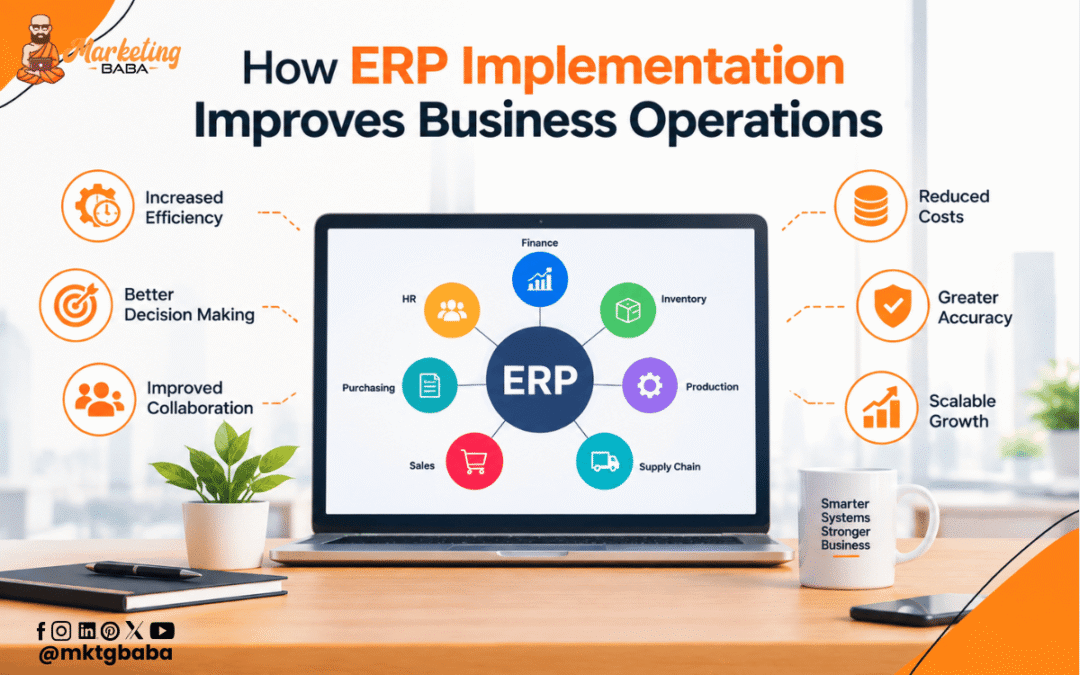
How ERP Implementation Improves Business Operations
How ERP Implementation Improves Business Operations is an important question for businesses looking to improve efficiency, manage resources, automate processes, and make better decisions. Enterprise Resource Planning (ERP) systems bring different business functions together on a single platform, helping organizations manage finance, sales, inventory, human resources, procurement, operations, and other activities more effectively.
As businesses grow, managing different departments with disconnected software, spreadsheets, and manual processes can become increasingly difficult. Data may be duplicated, communication can become slower, and managers may struggle to get an accurate view of business performance. An ERP system helps address these challenges by connecting important business processes and providing centralized information.
In this blog, Marketing Baba explains How ERP Implementation Improves Business Operations, the major benefits of ERP systems, and why businesses should consider ERP implementation as part of their digital transformation strategy.
What Is ERP Implementation?
ERP implementation is the process of introducing an Enterprise Resource Planning system into an organization. It involves planning, configuring, customizing, testing, deploying, and maintaining ERP software according to the organization’s business requirements.
An ERP system can connect multiple departments through a centralized platform. Instead of maintaining separate systems for finance, sales, inventory, purchasing, HR, and operations, businesses can manage these functions through an integrated solution.
Understanding How ERP Implementation Improves Business Operations starts with understanding this integration. When departments work with connected data, employees can access relevant information faster, reduce repetitive work, and coordinate activities more effectively.
1. Centralizes Business Data
One of the biggest advantages of ERP implementation is centralized data management.
Businesses often generate large amounts of information every day. Sales teams manage customer information, finance teams manage invoices and payments, inventory teams track stock, and HR teams maintain employee records. When this information is stored in different systems, maintaining consistency becomes difficult.
ERP software creates a centralized environment where authorized employees can access the information they need.
This is one of the clearest examples of How ERP Implementation Improves Business Operations. Centralized data reduces information silos and helps departments work with consistent and updated information.
For management teams, centralized data can also make reporting easier because important information is available through a connected system rather than multiple disconnected files.
2. Automates Repetitive Processes
Manual work can consume significant employee time. Tasks such as data entry, invoice generation, purchase processing, inventory updates, and reporting may involve repetitive activities.
ERP systems can automate many of these processes based on predefined workflows and business rules.
For example, when a sales order is created, relevant information can flow into inventory and financial processes without requiring employees to enter the same information repeatedly.
This automation demonstrates How ERP Implementation Improves Business Operations by reducing unnecessary manual work and allowing employees to focus on activities that require human judgment and creativity.
Automation can also help businesses establish standardized workflows, making processes more consistent across departments.
3. Improves Operational Efficiency
Operational efficiency is essential for businesses that want to manage resources effectively. Delays, duplicate data entry, manual approvals, and disconnected systems can slow down everyday operations.
ERP implementation helps businesses create more structured workflows. Employees can follow predefined processes, access required information, and collaborate through a common platform.
When processes become more organized, businesses can identify bottlenecks and improve workflow efficiency.
Therefore, How ERP Implementation Improves Business Operations can be understood through its ability to connect people, processes, and information in a more structured way.
4. Provides Real-Time Business Information
Business decisions depend on accurate information. If management receives outdated reports, it may be difficult to understand what is happening across the organization.
Modern ERP systems can provide access to updated operational and financial information, depending on the system configuration and business processes.
Managers can use dashboards and reports to monitor areas such as sales, inventory, expenses, orders, procurement, and other operational indicators.
This is another important aspect of How ERP Implementation Improves Business Operations. Better access to business information can help decision-makers respond to operational issues more quickly.
5. Enhances Financial Management
Financial management is a critical part of every organization. Businesses need to monitor revenue, expenses, invoices, payments, budgets, and other financial activities.
An ERP system can integrate financial processes with other departments. For example, sales transactions can connect with accounting processes, while purchasing activities can be linked with financial records.
This integration reduces the need to manually reconcile information between multiple systems.
Understanding How ERP Implementation Improves Business Operations also means recognizing its role in creating better connections between operational activities and financial management.
With centralized financial information, businesses can generate reports more efficiently and gain greater visibility into their financial operations.
6. Improves Inventory Management
Inventory management can become complicated when businesses handle multiple products, warehouses, suppliers, and customer orders.
An ERP system can help businesses track inventory-related information from a centralized platform. Depending on the ERP solution, businesses may monitor stock levels, purchase orders, sales orders, warehouse movements, and product information.
Better inventory visibility can help businesses identify stock shortages, excess inventory, and purchasing requirements.
This explains How ERP Implementation Improves Business Operations in businesses where inventory plays an important role. Better inventory information can support more organized purchasing and warehouse management.
7. Strengthens Procurement Processes
Procurement involves identifying requirements, selecting suppliers, creating purchase orders, receiving goods, and managing payments.
Without a structured system, procurement processes can involve significant manual coordination.
ERP software can connect purchasing activities with inventory and finance. Purchase requests can move through predefined approval processes, while procurement information can be tracked within the system.
This demonstrates How ERP Implementation Improves Business Operations by creating a more organized procurement workflow.
Businesses can also maintain supplier information and purchase histories, making procurement management more structured.
8. Improves Collaboration Between Departments
Departments often depend on each other. Sales may need inventory information, finance may need sales information, and purchasing may need information about stock requirements.
When each department uses separate systems, communication can become slower.
ERP implementation creates a shared information environment where authorized users can access relevant data.
This is an important part of How ERP Implementation Improves Business Operations, because better information sharing can support collaboration between teams.
Employees can spend less time requesting basic information from other departments and more time working on business activities.
9. Supports Better Customer Service
Customer expectations are continually increasing. Customers want accurate information, quick responses, and reliable order fulfillment.
ERP systems can connect customer orders with inventory, production, logistics, and financial processes, depending on the organization’s ERP setup.
When employees can access accurate order and customer information, they may be able to respond to customer queries more efficiently.
This is another way How ERP Implementation Improves Business Operations can influence the customer experience. Internal process improvements can contribute to faster and more organized customer service.
10. Improves Employee Productivity
Employees often lose valuable time searching for information, entering duplicate data, preparing manual reports, and following disconnected processes.
ERP automation and centralized information can reduce some of these inefficiencies.
Employees can use standardized workflows and dashboards to complete tasks more systematically.
This explains How ERP Implementation Improves Business Operations from an employee productivity perspective. Instead of spending excessive time on administrative tasks, employees can focus on activities that directly contribute to organizational objectives.
11. Reduces Operational Costs
Businesses constantly look for ways to control unnecessary costs while maintaining quality and productivity.
ERP systems can help identify inefficiencies, reduce duplicate processes, improve resource planning, and automate repetitive activities.
For example, better inventory visibility can help organizations manage purchasing more effectively, while automated financial workflows can reduce manual administrative work.
The cost impact depends on the ERP system, implementation quality, business size, and processes involved.
Nevertheless, How ERP Implementation Improves Business Operations includes the potential to create more efficient resource utilization and reduce avoidable operational expenses.
12. Enhances Reporting and Analytics
Business analytics are important for understanding performance and identifying opportunities for improvement.
ERP systems can consolidate information from different business functions, making it easier to generate reports.
Management may analyze sales performance, expenses, inventory, purchasing, employee information, and other business data depending on the ERP platform.
This demonstrates How ERP Implementation Improves Business Operations through improved visibility and reporting capabilities.
Instead of relying entirely on manually prepared spreadsheets, businesses can use system-generated reports and dashboards to support their analysis.
13. Helps Standardize Business Processes
As businesses grow, different teams may develop their own ways of performing similar tasks. This can create inconsistency and make management more difficult.
ERP implementation provides an opportunity to review existing workflows and establish standardized processes.
Businesses can define approval workflows, data structures, roles, and operational procedures within the ERP environment.
This highlights How ERP Implementation Improves Business Operations by encouraging process standardization.
Standardized processes can also make employee training easier because employees can follow clearly defined workflows.
14. Supports Business Scalability
A system that works for a small organization may not be sufficient when the organization expands.
As businesses add employees, products, locations, customers, and transactions, managing operations becomes more complex.
A properly selected ERP system can provide a scalable foundation for business operations.
This is another important example of How ERP Implementation Improves Business Operations. Instead of continuously adding disconnected software as the business grows, organizations can build their operations around an integrated platform.
However, scalability depends on selecting an ERP solution that matches the organization’s future requirements.
15. Strengthens Data Accuracy
Data accuracy is essential for effective business management.
When employees enter the same information into multiple systems, the possibility of errors increases. An integrated ERP system can reduce duplicate data entry by allowing information to flow between connected processes.
This can improve consistency across departments.
Therefore, How ERP Implementation Improves Business Operations also involves improving the quality and consistency of business data.
Accurate information can support better reporting, planning, customer service, financial management, and operational decision-making.
16. Improves Business Decision-Making
Managers need reliable information to make operational and strategic decisions.
An ERP system can provide a broader view of business activities by connecting information from different departments.
Management can use reports and dashboards to identify trends, monitor performance, and investigate operational issues.
This is one of the most significant answers to How ERP Implementation Improves Business Operations. When decision-makers have better visibility into business activities, they can evaluate situations using more organized and accessible information.
17. Supports Digital Transformation
Digital transformation is not simply about purchasing new software. It involves improving how an organization uses technology to manage processes, information, and customer experiences.
ERP implementation can become an important part of a broader digital transformation strategy.
By replacing disconnected manual processes with integrated digital workflows, organizations can create a stronger technological foundation.
This shows How ERP Implementation Improves Business Operations while supporting broader modernization initiatives.
18. Makes Compliance and Record-Keeping Easier
Businesses may need to maintain accurate records for financial, operational, tax, HR, or industry-specific requirements.
ERP systems can provide structured records and workflows that support organized documentation.
Access controls can also help businesses manage who can view or modify specific information, depending on the ERP solution.
This is another area where How ERP Implementation Improves Business Operations becomes relevant, particularly for organizations that need structured processes and reliable records.
19. Provides Better Resource Planning
Resources include employees, inventory, finances, equipment, time, and other assets.
Poor resource planning can lead to delays, unnecessary costs, and inefficient utilization.
ERP systems can bring information about different resources into a connected environment, helping businesses plan activities more effectively.
This further explains How ERP Implementation Improves Business Operations by providing organizations with better visibility into available resources and operational requirements.
20. Creates a Foundation for Long-Term Growth
An ERP system should not be viewed only as software for managing current tasks. It can become an important foundation for long-term operational improvement.
When business data, processes, and departments are connected, organizations can create a more structured operating environment.
This is the broader answer to How ERP Implementation Improves Business Operations. ERP implementation can help businesses move from fragmented processes toward integrated, data-driven operations.
Key Factors for Successful ERP Implementation
Understanding How ERP Implementation Improves Business Operations is only one part of the process. Successful implementation also requires careful planning.
Businesses should begin by identifying their operational challenges and defining clear objectives. They should determine which departments need to be integrated and what functionality is required.
Employee involvement is also important. Employees who use the system daily should understand how the ERP will change their workflows.
Data migration should be carefully planned and tested. Existing data may need to be cleaned, organized, and validated before being transferred to the new system.
Training is another essential component. Employees need sufficient training to use the ERP system effectively and understand new processes.
Finally, businesses should monitor the ERP system after implementation and continuously improve workflows based on operational requirements.
Common ERP Implementation Challenges
ERP implementation can provide significant operational benefits, but businesses may also face challenges.
Common challenges include:
- Resistance to change
- Poor implementation planning
- Inadequate employee training
- Data migration problems
- Lack of management involvement
- Unclear business requirements
- Excessive customization
- Integration difficulties
- Budget management issues
- Poor post-implementation support
Recognizing these challenges is important when evaluating How ERP Implementation Improves Business Operations because the benefits of ERP depend significantly on implementation quality.
A well-planned ERP project should consider business processes, employees, technology, data, security, integration, and long-term support.
Why Businesses Should Consider ERP Implementation
Modern businesses operate in an environment where speed, efficiency, accurate information, and collaboration are increasingly important.
Managing operations through disconnected systems can make it difficult to maintain visibility and consistency.
ERP implementation offers a way to bring multiple business processes together within a centralized digital environment.
The benefits discussed throughout this article demonstrate How ERP Implementation Improves Business Operations by improving data management, automation, collaboration, reporting, resource planning, financial visibility, inventory management, and operational efficiency.
However, ERP should not be treated as a one-size-fits-all solution. Businesses should evaluate their requirements, budget, processes, employees, industry needs, and future growth plans before selecting an ERP platform.
How Marketing Baba Can Help With Business Technology Solutions
At Marketing Baba, we understand that business growth increasingly depends on the effective combination of marketing, technology, and operational processes.
ERP implementation can help organizations create stronger internal systems while other digital solutions can support customer acquisition, communication, branding, and business growth.
Marketing Baba provides integrated marketing and business technology solutions designed to support modern organizations. From digital marketing and branding to business technology implementations, businesses can explore solutions based on their specific requirements.
For organizations considering ERP implementation, the first step is to understand existing operational challenges and identify the processes that can benefit most from automation and integration.
Conclusion
How ERP Implementation Improves Business Operations can be understood through its impact on efficiency, automation, data management, collaboration, reporting, resource planning, and decision-making.
An ERP system can connect departments, centralize information, automate repetitive processes, improve visibility, and create standardized workflows. It can also support financial management, inventory management, procurement, customer service, employee productivity, and long-term business scalability.
The success of ERP implementation depends on choosing the right solution, clearly defining business requirements, preparing employees, managing data properly, and providing continuous support after implementation.
For businesses looking to modernize their operations, ERP can become an important part of a broader digital transformation strategy.
Ultimately, How ERP Implementation Improves Business Operations is not only about implementing software. It is about creating a more connected, efficient, organized, and data-driven way of managing a business.
If your organization is exploring ERP implementation or other business technology solutions, Marketing Baba can help you identify digital opportunities that align with your business goals and operational requirements.