
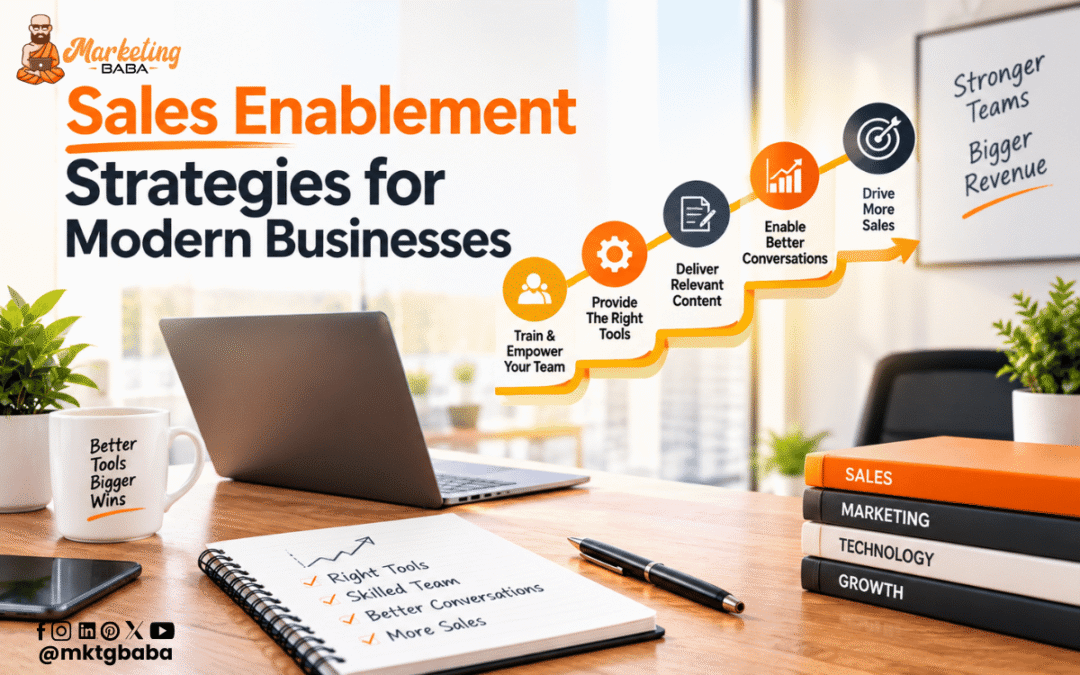
Sales Enablement Strategies for Modern Businesses
Sales Enablement Strategies for Modern Businesses are becoming increasingly important as companies look for better ways to improve sales performance, support sales teams, and create consistent customer experiences. In a competitive marketplace, having a good product or service is not always enough. Businesses need to equip their sales teams with the right resources, technology, knowledge, training, and processes to convert prospects into customers effectively.
Modern buyers are more informed than ever. Customers research products online, compare competitors, read reviews, and evaluate pricing before speaking with a salesperson. This means sales professionals need more than traditional selling techniques. They need access to accurate information, relevant content, customer insights, automation tools, and effective communication methods. This is where Sales Enablement Strategies for Modern Businesses can make a significant difference.
What Is Sales Enablement?
Sales enablement is the process of providing sales teams with the resources, tools, information, training, and support they need to perform their jobs effectively. It connects marketing, sales, technology, and business operations to create a more organized and productive sales process.
The purpose of Sales Enablement Strategies for Modern Businesses is to help sales representatives spend less time searching for information and more time engaging with prospects. A well-designed sales enablement program can improve communication, shorten sales cycles, strengthen customer relationships, and support revenue growth.
Sales enablement can include sales training, product education, content creation, CRM implementation, lead management, sales automation, performance tracking, customer research, and ongoing coaching.
Why Sales Enablement Matters for Modern Businesses
Traditional sales processes often depend heavily on individual salesperson experience. While experience remains valuable, modern businesses need scalable systems that help every sales representative perform consistently.
One of the major benefits of Sales Enablement Strategies for Modern Businesses is that they create a structured approach to selling. Instead of allowing salespeople to use disconnected resources and different processes, businesses can establish standardized methods for prospecting, presenting, following up, and closing deals.
Sales enablement can also improve collaboration between marketing and sales. Marketing teams create content and generate leads, while sales teams use those resources to engage prospects. When both departments work toward common objectives, businesses can create a smoother customer journey.
1. Align Sales and Marketing Teams
One of the most important Sales Enablement Strategies for Modern Businesses is creating stronger alignment between sales and marketing.
Marketing teams often understand customer segments, campaigns, content performance, and market trends. Sales teams interact directly with prospects and understand their questions, objections, requirements, and buying concerns.
When these insights are shared, both teams can work more effectively.
Businesses should establish regular communication between sales and marketing teams. They can discuss lead quality, campaign results, customer feedback, common objections, and content requirements.
This alignment helps marketing create useful sales materials while helping sales teams understand how marketing campaigns are designed to support customer acquisition.
2. Create a Centralized Sales Content Library
Sales representatives frequently need presentations, brochures, case studies, product information, pricing documents, FAQs, comparison sheets, and proposal templates.
Searching for these resources across different folders, emails, or messaging applications can waste valuable time.
A centralized content library is therefore one of the practical Sales Enablement Strategies for Modern Businesses.
Businesses can organize sales content into categories based on products, industries, customer stages, and sales objectives. Salespeople should be able to quickly locate the latest approved version of a document.
A centralized system also reduces the risk of sales representatives sharing outdated information with prospects.
3. Invest in Sales Training
Sales training should not be treated as a one-time activity. Markets, products, customer expectations, and competitors continuously change.
Continuous training is therefore an essential part of Sales Enablement Strategies for Modern Businesses.
Training can cover product knowledge, communication skills, objection handling, negotiation, prospecting, presentation skills, CRM usage, sales technology, and closing techniques.
Businesses can combine classroom sessions, online learning, workshops, role-playing exercises, and coaching sessions.
Regular training allows salespeople to build confidence and adapt to changing customer expectations.
4. Use CRM Technology Effectively
Customer Relationship Management, or CRM, is an important component of modern sales operations.
A CRM system can help businesses manage leads, track customer interactions, monitor opportunities, schedule follow-ups, and analyze sales performance.
Effective CRM usage is among the most valuable Sales Enablement Strategies for Modern Businesses because it provides sales teams with organized customer information.
Instead of maintaining scattered spreadsheets or relying on memory, salespeople can access customer information from a centralized platform.
CRM data can also help managers identify bottlenecks in the sales pipeline and understand where prospects are dropping out.
5. Develop Buyer-Focused Sales Content
Modern customers want information that answers their specific questions. Generic promotional content may not always be enough to move a prospect toward a purchase.
Creating buyer-focused content is another important element of Sales Enablement Strategies for Modern Businesses.
Sales content should address customer problems, explain solutions, demonstrate benefits, answer common questions, and provide useful evidence.
Examples include:
- Product brochures
- Case studies
- Customer success stories
- Industry reports
- Product comparison guides
- Frequently asked questions
- Demonstration videos
- Proposal templates
- Presentation decks
- Educational blogs
When sales representatives have relevant content for different stages of the buying journey, they can provide more meaningful information to prospects.
6. Automate Repetitive Sales Tasks
Salespeople often spend considerable time performing repetitive administrative tasks such as sending follow-up emails, updating records, scheduling meetings, and organizing leads.
Automation can reduce this workload.
Sales automation is therefore another useful component of Sales Enablement Strategies for Modern Businesses.
Businesses can automate lead assignments, email sequences, reminders, appointment scheduling, notifications, and certain reporting activities.
Automation does not eliminate the need for human interaction. Instead, it allows sales representatives to focus more attention on conversations that require personal communication.
7. Improve Lead Management
Generating leads is only one part of the sales process. Businesses also need systems to qualify, prioritize, distribute, and follow up with those leads.
Strong lead management is an important part of Sales Enablement Strategies for Modern Businesses.
Businesses can define lead qualification criteria based on factors such as customer needs, industry, company size, budget, engagement level, and buying intent.
Clear qualification processes help sales teams prioritize prospects and reduce time spent on leads that are unlikely to convert.
8. Use Data to Improve Sales Performance
Modern businesses have access to large amounts of sales and customer data. However, data becomes valuable only when businesses use it to make informed operational decisions.
Data-driven decision-making should therefore be included in Sales Enablement Strategies for Modern Businesses.
Businesses can monitor metrics such as:
- Lead conversion rate
- Sales cycle length
- Opportunity value
- Win rate
- Follow-up performance
- Customer acquisition cost
- Revenue per salesperson
- Pipeline velocity
- Customer retention
Analyzing these metrics can help managers identify areas that require improvement and understand which parts of the sales process are working effectively.
9. Personalize Customer Communication
Customers increasingly expect businesses to understand their needs. Personalized communication can make sales conversations more relevant.
Personalization is consequently another valuable component of Sales Enablement Strategies for Modern Businesses.
Sales representatives can use CRM information, previous interactions, industry information, and customer requirements to personalize emails, presentations, demonstrations, and proposals.
Instead of sending the same message to every prospect, sales teams can focus their communication on the specific problems and goals of each customer.
10. Strengthen Sales and Customer Experience
Sales enablement should not focus only on closing deals. It should also support the overall customer experience.
Customers interact with businesses through websites, social media, emails, phone calls, meetings, advertisements, and sales representatives. Consistency across these channels can improve trust and clarity.
Customer experience should therefore be considered when developing Sales Enablement Strategies for Modern Businesses.
Sales teams should have access to accurate brand information, product details, communication guidelines, and customer insights. This helps create a more consistent experience throughout the buying journey.
11. Use Sales Coaching and Feedback
Sales managers play an important role in helping sales representatives improve.
Regular coaching can help identify strengths, weaknesses, communication issues, and opportunities for improvement.
Sales coaching is one of the sustainable Sales Enablement Strategies for Modern Businesses because it supports continuous development rather than relying only on occasional training.
Managers can review sales calls, analyze deals, discuss objections, provide feedback, and create individual development plans.
Constructive feedback can help sales representatives improve their approach while building stronger professional skills.
12. Make Mobile Access Available
Sales teams are not always working from an office. Representatives may visit customers, attend exhibitions, conduct demonstrations, or travel for meetings.
Mobile access to CRM systems, presentations, customer information, proposals, and other resources can make sales operations more flexible.
Mobile accessibility is therefore another practical element of Sales Enablement Strategies for Modern Businesses.
Sales representatives should be able to securely access essential information whenever they need it, whether they are working from an office or meeting a customer outside the workplace.
13. Build a Consistent Sales Process
A consistent sales process helps businesses create predictable workflows.
Without a defined process, different sales representatives may handle similar prospects in completely different ways. This can create inconsistent customer experiences and make performance difficult to measure.
Creating a structured sales process is one of the foundational Sales Enablement Strategies for Modern Businesses.
A sales process can define stages such as prospecting, qualification, discovery, presentation, proposal, negotiation, closing, and post-sale follow-up.
Clear stages help salespeople understand what actions should be taken at each point.
14. Integrate Marketing Technology and Sales Technology
Businesses often use multiple platforms for marketing, CRM, communication, advertising, analytics, and customer management.
Integrating these systems can help information move more efficiently between departments.
Technology integration is therefore an important part of Sales Enablement Strategies for Modern Businesses.
For example, information collected through marketing campaigns can be transferred to CRM systems, allowing sales representatives to understand how a prospect interacted with a campaign before initiating a conversation.
Better integration can reduce manual data entry and improve visibility across the organization.
15. Measure and Improve Sales Enablement Programs
Sales enablement should be measured regularly. Businesses need to understand whether their efforts are improving sales productivity and customer engagement.
Performance measurement is one of the essential Sales Enablement Strategies for Modern Businesses.
Businesses can compare metrics before and after implementing new training programs, technology, content systems, or processes.
Useful measurements may include sales productivity, conversion rates, sales cycle duration, content usage, training completion, and revenue performance.
Regular evaluation allows organizations to identify what needs improvement and adjust their sales enablement approach.
Common Challenges in Sales Enablement
Although sales enablement can provide significant operational benefits, businesses may face challenges during implementation.
One common challenge is lack of alignment between departments. Sales and marketing teams may have different objectives or definitions of a qualified lead.
Another challenge is poor adoption of technology. Implementing a CRM or sales enablement platform does not automatically guarantee that employees will use it correctly.
Content management can also become difficult when businesses create large amounts of sales material without a clear organizational system.
To overcome these challenges, organizations should focus on communication, training, leadership support, process clarity, and regular evaluation.
The Role of Technology in Sales Enablement
Technology continues to influence the way businesses manage sales operations. CRM platforms, automation tools, analytics systems, communication platforms, artificial intelligence, and content management systems can support different stages of the sales process.
However, technology should support a clearly defined sales process rather than replace one.
Effective Sales Enablement Strategies for Modern Businesses combine technology with human skills. Sales representatives still need communication, empathy, negotiation, product knowledge, and relationship-building abilities.
The right technology can provide information and efficiency, while people provide the human connection required for meaningful customer relationships.
How Marketing Baba Can Support Business Growth
At Marketing Baba, we understand that modern businesses need an integrated approach to marketing, technology, and customer engagement. Effective Sales Enablement Strategies for Modern Businesses can work alongside digital marketing, lead generation, CRM implementation, branding, content marketing, advertising, and other business growth initiatives.
Marketing Baba provides online and offline marketing solutions designed to help organizations connect with their target audiences and strengthen their market presence.
From lead generation and SEO to social media marketing, content marketing, branding, website development, CRM implementation, and promotional campaigns, businesses can use integrated services to support different stages of their customer journey.
A strong connection between marketing activities and sales processes can help organizations create a more organized approach to acquiring and engaging customers.
Conclusion
Sales Enablement Strategies for Modern Businesses provide a structured way for organizations to support sales teams, improve processes, strengthen customer communication, and use technology more effectively.
From sales training and CRM implementation to content management, automation, lead qualification, data analysis, and sales coaching, businesses can develop a comprehensive sales enablement framework based on their specific goals.
The most effective approach is not simply to add more tools. Businesses should focus on creating systems that make it easier for sales teams to access information, communicate with prospects, manage opportunities, and build lasting customer relationships.
As customer expectations continue to evolve, organizations that continuously improve their sales processes can create stronger foundations for sustainable growth. By combining people, processes, content, technology, and data, Sales Enablement Strategies for Modern Businesses can become an important part of a modern business growth strategy.
-
Digital Marketing in 2026: What’s Working, What’s Dead, and What’s Next: Read More
-
9 Ultimate Lead Generation Secrets Revealed: Read More
-
8 Fresh Content Ideas to Engage Your Audience: Read More