
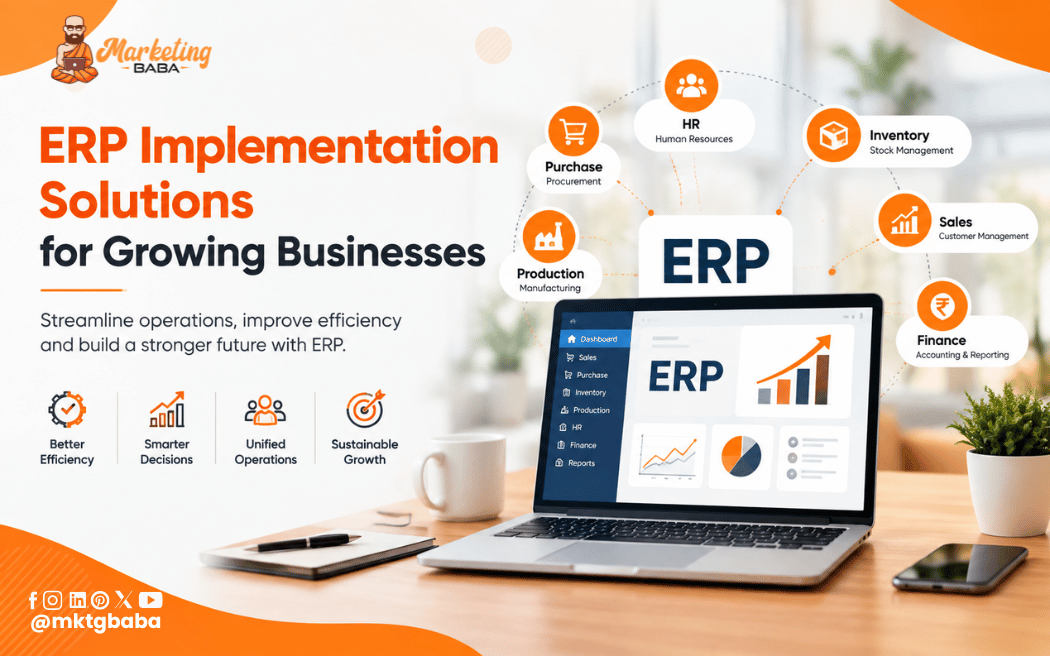
ERP Implementation Solutions for Growing Businesses
ERP Implementation Solutions for Growing Businesses are becoming increasingly important as companies expand their operations, teams, customers, products, and business processes. As a business grows, managing finance, sales, inventory, human resources, purchasing, customer information, and other operations through separate systems can become difficult. An effective ERP system brings these functions together in one integrated platform, helping businesses improve visibility, streamline workflows, reduce manual work, and make better-informed decisions.
For growing organizations, technology is no longer simply a support function. It plays an important role in improving productivity, managing resources, and creating scalable processes. This is where ERP Implementation Solutions for Growing Businesses can provide significant value. By implementing the right ERP system with a structured strategy, organizations can connect departments, centralize information, automate repetitive tasks, and create a stronger foundation for future growth.
What Are ERP Implementation Solutions for Growing Businesses?
ERP Implementation Solutions for Growing Businesses refer to the planning, customization, deployment, integration, testing, training, and ongoing management involved in introducing an Enterprise Resource Planning system into a growing organization.
ERP software typically connects multiple business functions through a centralized platform. Depending on the organization’s requirements, an ERP system may include modules for:
- Finance and accounting
- Sales management
- Purchase management
- Inventory management
- Human resources
- Payroll
- Customer relationship management
- Supply chain management
- Project management
- Manufacturing
- Reporting and analytics
Instead of maintaining disconnected information across spreadsheets and different software applications, an ERP system allows businesses to manage important information through an integrated environment.
The purpose of ERP Implementation Solutions for Growing Businesses is not simply to install software. A successful implementation aligns the ERP platform with the organization’s business processes, goals, employees, and future requirements.
Why Growing Businesses Need ERP Systems
Growth creates opportunities, but it also introduces operational complexity. A company that manages 20 employees and a small number of customers may be able to handle many processes manually. As the organization grows, the same methods can become inefficient.
More employees mean more HR and payroll requirements. More customers mean more sales and customer information. More products mean more inventory management. More transactions mean greater accounting complexity.
This is why ERP Implementation Solutions for Growing Businesses can become an important part of a company’s technology strategy.
An ERP system can help organizations establish standardized processes before operational challenges become difficult to manage. It can also provide management with a centralized view of business activities.
Key Benefits of ERP Implementation
1. Centralized Business Information
One of the major benefits of ERP Implementation Solutions for Growing Businesses is centralized data management.
Without an ERP system, different departments may maintain their own records. Finance may use one application, sales may use another, and inventory information may exist in spreadsheets.
An ERP platform can bring these functions together. Authorized users can access relevant information from a common system, reducing unnecessary duplication and improving information consistency.
2. Improved Operational Efficiency
Manual processes can consume considerable employee time. Data entry, document preparation, reporting, reconciliation, and information sharing may require repetitive work.
ERP Implementation Solutions for Growing Businesses can automate many routine processes. For example, sales information can flow into inventory and accounting processes without requiring employees to enter the same information repeatedly.
Automation can help employees spend more time on activities that require analysis, communication, problem-solving, and strategic decision-making.
3. Better Financial Management
Financial management becomes more complex as a company grows.
ERP systems can connect financial information with sales, purchasing, inventory, expenses, and other operational activities. This gives finance teams a more integrated view of business transactions.
With appropriate configuration, ERP Implementation Solutions for Growing Businesses can help organizations improve financial reporting, monitor expenses, manage receivables and payables, and maintain more structured accounting processes.
4. Better Inventory Management
Inventory errors can affect customer satisfaction, cash flow, and profitability.
Businesses need to know what products are available, what has been sold, what has been purchased, and what needs to be reordered.
ERP software can connect inventory information with sales and purchasing activities. As a result, businesses can gain better visibility into stock movement and inventory requirements.
This makes inventory management another important area where ERP Implementation Solutions for Growing Businesses can create operational value.
5. Improved Decision-Making
Business decisions depend on accurate and timely information.
When information is distributed across multiple systems, managers may spend significant time collecting and consolidating data before making decisions.
An ERP system can provide dashboards, reports, and analytics based on centralized information. This can help business leaders monitor important performance indicators and understand operational trends.
For growing companies, ERP Implementation Solutions for Growing Businesses can therefore support data-driven management.
ERP Implementation Process
Implementing ERP software requires careful planning. The process should be treated as a business transformation project rather than simply a software installation.
Step 1: Understand Business Requirements
The first step is identifying the organization’s current processes, challenges, goals, and technology requirements.
Businesses should determine which departments need ERP support and which processes should be automated or integrated.
A clear requirements analysis helps ensure that ERP Implementation Solutions for Growing Businesses are aligned with actual business needs.
Step 2: Select the Right ERP Platform
There are many ERP platforms available in the market. However, not every system is suitable for every organization.
Businesses should evaluate ERP platforms based on factors such as:
- Business size
- Industry requirements
- Number of users
- Required modules
- Integration capabilities
- Scalability
- Security
- Customization requirements
- Budget
- Vendor support
The objective of ERP Implementation Solutions for Growing Businesses should be to select a platform that meets current requirements while remaining capable of supporting future expansion.
Step 3: Plan the Implementation
Once the ERP platform is selected, the implementation team should create a structured project plan.
The plan can include timelines, responsibilities, data requirements, integrations, testing stages, training, and deployment activities.
Effective planning reduces confusion and helps different departments understand their responsibilities.
Step 4: Data Migration
Businesses often have important information stored in existing software, spreadsheets, databases, and documents.
This information may need to be cleaned, organized, validated, and migrated into the new ERP system.
Data migration is an important component of ERP Implementation Solutions for Growing Businesses because inaccurate or duplicate data can create problems after implementation.
Step 5: ERP Configuration and Integration
The ERP system should be configured according to the organization’s approved processes.
It may also need to connect with other business applications such as CRM platforms, payment systems, e-commerce platforms, HR systems, or third-party applications.
Proper integration can create a connected technology environment and reduce duplicate data entry.
Step 6: Testing
Before launching the ERP system, businesses should conduct comprehensive testing.
Testing can cover:
- User access
- Data accuracy
- Workflows
- Reports
- Integrations
- Financial transactions
- Inventory processes
- Automated activities
- Security permissions
Testing helps identify issues before the ERP system becomes operational across the organization.
Step 7: Employee Training
Technology implementation is only successful when employees can use the system effectively.
Employees should receive training based on their responsibilities. Finance users may need different training from sales, HR, inventory, or management teams.
Training is therefore an essential part of ERP Implementation Solutions for Growing Businesses.
Step 8: Go-Live and Ongoing Support
After testing and training, the organization can move to the live ERP environment.
However, implementation does not end on the go-live date. Employees may have questions, new requirements may emerge, and processes may need optimization.
Continuous support helps businesses maximize the value of their ERP investment.
Common Challenges During ERP Implementation
Although ERP systems offer many advantages, implementation can present challenges.
Resistance to Change
Employees who are comfortable with existing processes may initially resist new software.
Clear communication and practical training can help employees understand how the ERP system will affect their daily responsibilities.
Poor Planning
Implementing ERP without clearly defining requirements can create unnecessary complications.
Businesses should establish project objectives, responsibilities, timelines, and measurable outcomes before implementation begins.
Data Quality Problems
Poor-quality data can negatively affect ERP performance.
Before migration, organizations should review existing records and remove duplicate, outdated, or incorrect information wherever appropriate.
Excessive Customization
Businesses may want the ERP platform to replicate every existing process. However, excessive customization can increase implementation costs and make future upgrades more difficult.
A better approach is to evaluate whether existing processes should be improved or standardized rather than automatically customizing the ERP system.
Lack of User Adoption
Even a technically successful ERP implementation may fail to deliver expected benefits if employees do not use the system correctly.
User training, communication, support, and management involvement are important for successful adoption.
How ERP Supports Business Growth
Growth requires scalability. A company should be able to add employees, customers, products, locations, and transactions without creating unnecessary operational complexity.
ERP Implementation Solutions for Growing Businesses can provide a structured technology foundation that supports this scalability.
For example, when a company expands into a new location, an ERP platform can help standardize financial, inventory, purchasing, HR, and reporting processes.
Similarly, when sales volume increases, integrated systems can help departments manage the additional workload more efficiently.
The exact benefits depend on the ERP platform, implementation quality, business processes, and level of user adoption.
ERP Integration With Other Business Systems
Modern businesses rarely operate with one software platform alone.
Organizations may use CRM software, e-commerce platforms, payment gateways, HR applications, marketing platforms, communication tools, and specialized industry applications.
ERP Implementation Solutions for Growing Businesses can include integrations that allow information to move between these systems.
For example, an e-commerce order could potentially be connected with inventory and accounting processes. Similarly, CRM information can be integrated with sales and customer management workflows.
The objective is to create a connected business ecosystem rather than another isolated software application.
ERP and Business Process Automation
Automation is one of the major reasons organizations invest in ERP technology.
Businesses can automate selected processes such as:
- Purchase approvals
- Invoice processing
- Payroll workflows
- Inventory alerts
- Sales order processing
- Financial reporting
- Employee workflows
- Customer data updates
- Approval notifications
When repetitive tasks are automated, employees can focus on more valuable activities.
This makes process automation an important component of ERP Implementation Solutions for Growing Businesses.
Choosing the Right ERP Implementation Partner
The technology platform is only one part of an ERP project. The implementation partner can also play an important role.
Businesses should evaluate potential implementation partners based on their understanding of business processes, technical expertise, integration capabilities, implementation methodology, training approach, and post-implementation support.
A reliable partner should first understand the organization’s requirements rather than simply recommending a software platform.
The right approach to ERP Implementation Solutions for Growing Businesses should consider both technology and business strategy.
How Marketing Baba Can Support Business Technology Growth
At Marketing Baba, we understand that modern business growth involves more than marketing alone. Businesses also need connected systems, streamlined processes, and technology that can support operational expansion.
Our approach to ERP Implementation Solutions for Growing Businesses focuses on understanding business requirements and helping organizations move toward more integrated and efficient operations.
ERP implementation can be considered alongside other business technology requirements such as CRM and HRMS implementations. Connecting these systems can help organizations establish a more structured digital business environment.
Marketing Baba focuses on combining strategy, technology, implementation, and execution to help businesses improve their overall operational ecosystem.
Measuring ERP Implementation Success
Businesses should define measurable objectives before starting an ERP project.
Possible indicators can include:
- Reduction in manual data entry
- Faster reporting
- Improved inventory visibility
- Reduced processing time
- Better financial control
- Improved data accuracy
- Faster approval workflows
- Higher employee adoption
- Improved access to business information
The appropriate measurements will vary from one organization to another.
A successful ERP project should ultimately support the business objectives for which the system was introduced.
Future of ERP for Growing Businesses
ERP technology continues to evolve with cloud computing, artificial intelligence, automation, analytics, mobile applications, and system integrations.
Cloud-based ERP platforms can provide businesses with flexible access to applications and centralized data, depending on the provider and deployment model.
AI-powered features may also assist with forecasting, reporting, automation, and data analysis.
As technology develops, ERP Implementation Solutions for Growing Businesses are likely to become increasingly connected with other business applications and digital workflows.
Organizations should therefore consider both their immediate requirements and long-term technology roadmap when selecting an ERP solution.
Conclusion
ERP Implementation Solutions for Growing Businesses can help organizations create a more connected, structured, and scalable operational environment. From finance and inventory to HR, sales, purchasing, and reporting, ERP systems can bring multiple business functions together through an integrated platform.
However, ERP implementation is not simply about purchasing software. Successful implementation requires business analysis, appropriate platform selection, data preparation, process planning, integration, testing, employee training, and ongoing support.
For growing organizations, the right ERP Implementation Solutions for Growing Businesses can help reduce operational complexity while creating a technology foundation for future expansion. Businesses that carefully evaluate their requirements and implement ERP with a structured approach can improve visibility, automation, collaboration, and process management.
At Marketing Baba, we help businesses explore technology and growth solutions that align with their evolving requirements. From ERP implementation to CRM and HRMS implementation, our focus is on helping organizations build more connected and efficient business operations.
If your business is growing and existing systems are becoming difficult to manage, ERP Implementation Solutions for Growing Businesses can be an important step toward creating a more organized and scalable operation. Evaluate your current processes, identify areas that require improvement, and choose an ERP implementation strategy that supports both your present needs and future business goals.
-
Digital Marketing in 2026: What’s Working, What’s Dead, and What’s Next: Read More
-
9 Ultimate Lead Generation Secrets Revealed: Read More
-
8 Fresh Content Ideas to Engage Your Audience: Read More