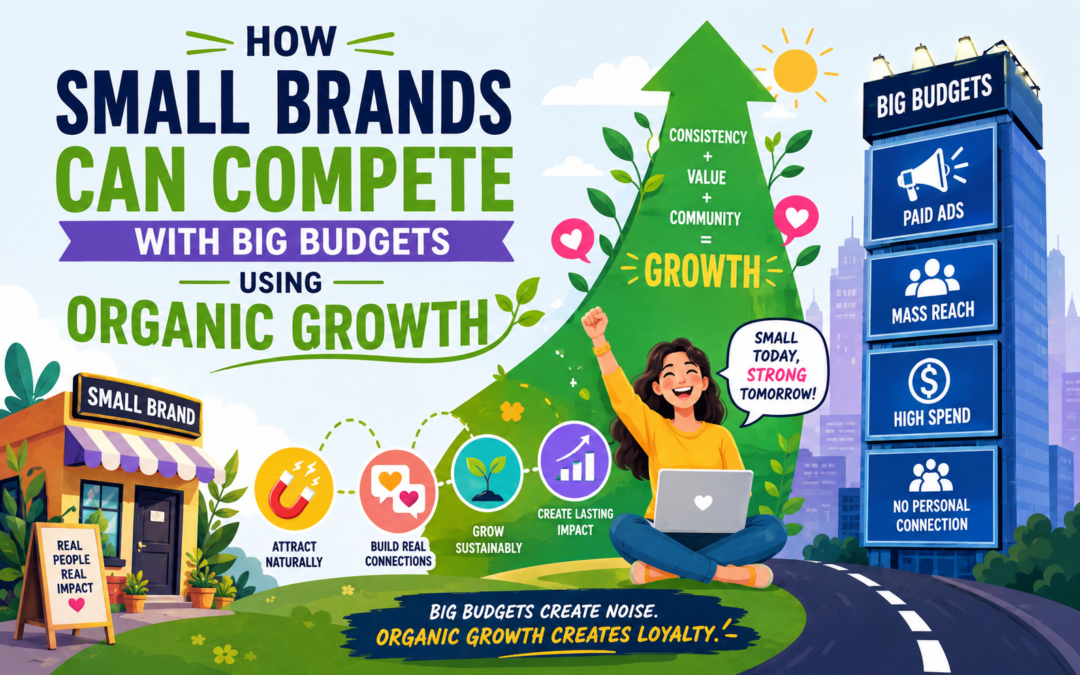
How Small Brands Can Compete with Big Budgets Using Organic Growth
Let’s be honest — when you’re a small brand staring down competitors who spend more on a single ad campaign than your entire annual revenue, it can feel like you’re bringing a slingshot to a cannon fight.
But here’s the thing: David beat Goliath. And in the digital world, organic growth is your slingshot.
Big brands have money. You have something they’ve largely lost — authenticity, agility, and a real human story. Used right, those three things can outperform any paid media budget. Here’s how.
1. Own a Niche, Don’t Fight for the Masses
Big brands have to appeal to everyone. That’s actually their weakness.
You don’t need a million customers. You need the right thousand. Instead of trying to rank for “running shoes,” go after “minimalist running shoes for flat feet.” Instead of targeting “healthy food,” own “high-protein meal prep for busy moms.”
The narrower your niche, the easier it is to dominate it organically — and the more loyal your audience becomes.
What to do: Define your micro-niche clearly. Build your content, SEO strategy, and social presence entirely around it. Become the go-to voice for that specific community.
2. Content is Your Most Valuable, Long-Term Asset
A paid ad disappears the moment you stop paying for it. A well-written blog post, YouTube video, or Instagram carousel can drive traffic for years.
Small brands that invest in consistent, genuinely helpful content build compounding returns over time. Big brands churn out content at scale but often lack depth and personality. Your content can win on both.
What to do:
- Start a blog that answers real questions your customers ask
- Create how-to videos that showcase your product’s value without being salesy
- Repurpose every piece of content across platforms (one blog = 5 social posts = 1 email = 1 reel)
3. Be Human Where Big Brands Are Corporate
People don’t connect with logos — they connect with people. The founder behind a brand, the team’s behind-the-scenes moments, the story of why the brand exists — these are things no Fortune 500 company can fake.
Your “smallness” is your superpower. Use it.
What to do: Show your face. Share your story. Post the messy middle, not just the polished highlights. Introduce your team. Let people root for you — because when they feel invested in your journey, they become your most powerful marketers.
4. Build Community, Not Just an Audience
An audience watches. A community participates.
Big brands have followers. Small brands can have tribes. Create spaces — a WhatsApp group, a Facebook community, a Discord server, a LinkedIn newsletter — where your customers talk to each other, not just to you. When people feel they belong somewhere, they stay, they share, and they bring others in.
What to do: Pick one community platform that fits your audience. Show up there consistently. Start conversations, ask questions, celebrate members. Community takes time to build but becomes the most defensible moat a brand can have.
5. Leverage Local and Micro-Influencers
You don’t need Bollywood celebrities or mega-influencers to get noticed. In fact, research consistently shows that micro-influencers (5K–100K followers) drive far higher engagement rates than celebrity accounts.
A local food blogger reviewing your product, a fitness coach recommending your supplement, a mom creator unboxing your baby brand — these feel real because they are real. And real converts.
What to do: Identify 10–20 micro-influencers in your niche. Reach out with genuine relationship-building, not just a one-off post deal. Offer value — free product, revenue share, exclusive experiences — and build long-term partnerships.
6. Master SEO — The Organic Traffic Machine
Search engine optimization is the great equaliser. Google doesn’t care how big your ad budget is — it cares about relevance, helpfulness, and authority.
A small brand with a focused SEO strategy can outrank giants for the right keywords. It takes time, but the traffic you earn is free and compounding.
What to do:
- Use free tools like Google Search Console, Ubersuggest, or Ahrefs’ free tier to find low-competition, high-intent keywords
- Write long-form, genuinely useful content around those keywords
- Build backlinks through guest posts, collaborations, and getting featured in roundups
- Optimise your Google Business Profile if you have a local presence
7. Email: The Channel You Actually Own
Social media algorithms can kill your reach overnight. Your email list? That’s yours.
Email marketing consistently delivers the highest ROI of any digital channel — and it doesn’t require a big budget to do well. A small, engaged list of 2,000 people who love your brand is worth more than 50,000 passive social followers.
What to do: Start building your list from day one. Offer a lead magnet (discount, free guide, checklist). Send emails that are worth reading — helpful, personal, occasionally entertaining. Treat your subscribers like VIPs, and they’ll act like it.
8. Collaborate with Other Small Brands
This is one of the most underused tactics in small business marketing. Find brands that share your audience but aren’t your competitors. Partner on giveaways, co-created content, bundle deals, or joint Instagram Lives.
You each tap into the other’s audience at zero cost, and both communities see you as more credible because someone they already trust vouched for you.
What to do: Make a list of 5 complementary brands at a similar stage to yours. Reach out with a specific, mutually beneficial collaboration idea. Keep it simple to start — a joint giveaway or a shared blog post — and build from there.
9. Turn Customers into Advocates
Word-of-mouth has always been the most powerful marketing. The digital era has just scaled it.
Happy customers who post about you, tag you, leave reviews, and recommend you to friends are worth more than any campaign. Create experiences worth talking about — exceptional packaging, personal thank-you notes, surprise upgrades, fast and genuinely human customer service.
What to do: Ask happy customers for reviews and testimonials actively. Create a referral programme. Repost user-generated content (with credit). Make every customer feel like the only customer.
The Bottom Line
Big brands have budgets. But they’ve traded their soul for scale.
As a small brand, you have what money can’t easily buy: a real story, a genuine connection with your audience, the ability to move fast, and the freedom to be human.
Organic growth is slower than paid advertising — but it’s stickier, more sustainable, and builds something no ad spend can replicate: trust.
Play the long game. Stay consistent. Be genuinely useful. The brands doing this today are the ones customers will talk about for years — not because of what they spent, but because of who they were.
-
Digital Marketing in 2026: What’s Working, What’s Dead, and What’s Next: Read More
-
9 Ultimate Lead Generation Secrets Revealed: Read More
-
8 Fresh Content Ideas to Engage Your Audience: Read More