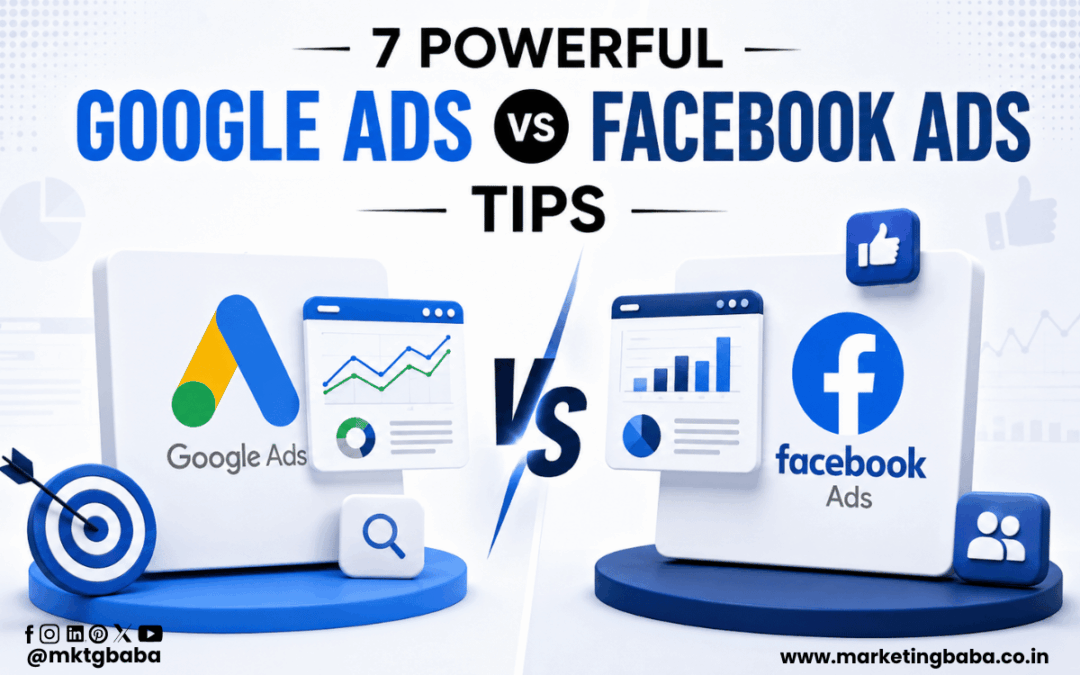
7 Powerful Google Ads vs Facebook Ads Tips
7 Powerful Google Ads vs Facebook Ads Tips can help businesses choose the right advertising platform, maximize return on investment (ROI), and generate quality leads. Every business owner wants to spend their marketing budget wisely, but selecting between Google Ads and Facebook Ads can be confusing. Both platforms are industry leaders in digital advertising, yet they work in completely different ways.
At Marketing Baba, we help businesses build result-driven digital marketing strategies that improve visibility, attract customers, and increase conversions. Understanding these 7 Powerful Google Ads vs Facebook Ads Tips will help you make informed advertising decisions, whether you are a startup, local business, or established brand.
In this guide, we will compare both platforms in detail, explain their strengths and weaknesses, and show you how to use them effectively for business growth.
Why Compare Google Ads and Facebook Ads?
Before spending your advertising budget, it is important to understand what each platform offers. Many businesses assume one platform is always better than the other, but that is not true. The right choice depends on your business goals, target audience, products, and budget.
Google Ads reaches people actively searching for products or services. Facebook Ads, on the other hand, helps businesses reach users based on interests, demographics, and online behavior.
These 7 Powerful Google Ads vs Facebook Ads Tips will explain when to use each platform and how to get the best possible results.
Understanding Google Ads
Google Ads is Google’s pay-per-click (PPC) advertising platform. It allows businesses to display advertisements on Google Search, YouTube, Google Display Network, Gmail, and partner websites.
When users search for keywords like “best digital marketing agency” or “website development services,” Google Ads displays relevant advertisements at the top of search results.
Advantages of Google Ads
- High purchase intent
- Instant visibility
- Keyword targeting
- Location targeting
- Multiple campaign types
- Measurable performance
- Excellent lead generation
Google Ads works exceptionally well for businesses that want immediate traffic and customers who are already searching for their services.
One of the most important 7 Powerful Google Ads vs Facebook Ads Tips is understanding that Google Ads captures existing demand rather than creating new demand.
Understanding Facebook Ads
Facebook Ads, managed through Meta Ads Manager, allow businesses to advertise across Facebook, Instagram, Messenger, and Audience Network.
Unlike Google Ads, Facebook Ads target users based on their interests, hobbies, age, education, profession, location, shopping behavior, and online activities.
Businesses use Facebook Ads to create awareness, engage audiences, increase followers, generate leads, and boost online sales.
Advantages of Facebook Ads
- Detailed audience targeting
- Lower cost per impression
- Excellent brand awareness
- Highly visual advertisements
- Remarketing capabilities
- Instagram integration
- Strong engagement rates
Another valuable lesson among these 7 Powerful Google Ads vs Facebook Ads Tips is that Facebook Ads create demand instead of simply capturing it.
Google Ads vs Facebook Ads: Quick Comparison
| Feature | Google Ads | Facebook Ads |
|---|---|---|
| Audience Intent | High purchase intent | Interest-based audience |
| Best For | Lead generation | Brand awareness |
| Cost | Usually higher CPC | Lower CPC |
| Targeting | Keywords | Interests & behavior |
| Conversion Speed | Fast | Medium |
| Visual Content | Limited in Search | Highly visual |
| Best Campaign Goal | Sales | Awareness & Engagement |
This comparison forms the foundation of these 7 Powerful Google Ads vs Facebook Ads Tips because choosing the right platform depends on understanding these differences.
Tip 1: Understand Customer Intent Before Choosing a Platform
The first and most important among these 7 Powerful Google Ads vs Facebook Ads Tips is understanding customer intent.
Customer intent refers to what users are trying to achieve when they see your advertisement.
Google Ads Targets Active Buyers
Google users actively search for solutions.
Examples include:
- Buy office furniture
- Best SEO company
- Website development services
- Restaurant near me
- Affordable laptops
These users already want a solution.
Google Ads simply places your business in front of them.
That is why Google Ads generally produces higher conversion rates.
Facebook Ads Targets Potential Buyers
Facebook users are scrolling through content.
They are not necessarily looking to buy anything.
Instead, Facebook introduces products to people who may become interested.
For example:
A user interested in fitness suddenly sees an advertisement for protein supplements.
A parent sees an advertisement for educational toys.
A fashion lover sees advertisements for clothing brands.
These advertisements create buying interest.
Understanding this difference is one of the most valuable 7 Powerful Google Ads vs Facebook Ads Tips because it helps businesses avoid spending money on the wrong platform.
When to Choose Google Ads
Choose Google Ads if your goal is:
- Lead generation
- Emergency services
- High-ticket products
- Local business inquiries
- Service bookings
When to Choose Facebook Ads
Choose Facebook Ads if your goal is:
- Brand awareness
- Community building
- Product launches
- Social engagement
- Building trust
Businesses that understand customer intent consistently achieve better advertising performance.
Tip 2: Match Your Campaign Goal with the Right Platform
The second lesson in these 7 Powerful Google Ads vs Facebook Ads Tips is selecting the correct campaign objective.
Many businesses fail because they expect every advertising platform to deliver the same results.
Instead, each platform performs best with specific objectives.
Best Goals for Google Ads
Google Ads performs exceptionally well for:
- Sales
- Website traffic
- Phone calls
- Appointment bookings
- Local services
- E-commerce purchases
Since users are actively searching, Google Ads often delivers quicker conversions.
Best Goals for Facebook Ads
Facebook Ads excel at:
- Brand awareness
- Video views
- Engagement
- Lead forms
- Event promotion
- App installs
- Community growth
This makes Facebook Ads ideal for businesses looking to build long-term customer relationships.
Following these 7 Powerful Google Ads vs Facebook Ads Tips helps businesses align their advertising spend with realistic outcomes rather than expecting identical performance from different platforms.
Tip 3: Know Which Platform Fits Your Budget
Budget planning is another essential part of these 7 Powerful Google Ads vs Facebook Ads Tips.
Many business owners believe that expensive advertising automatically delivers better results.
In reality, success depends on optimizing campaigns rather than simply increasing budgets.
Google Ads Budget
Google Ads usually has:
- Higher cost per click
- Stronger buying intent
- Faster lead generation
- Better conversion quality
Although clicks can be expensive, businesses often recover costs through higher-value conversions.
Facebook Ads Budget
Facebook Ads generally offer:
- Lower cost per click
- Lower cost per thousand impressions
- Better audience reach
- Affordable brand awareness
Businesses with limited budgets often start with Facebook Ads to build visibility before investing heavily in Google Ads.
Budget Allocation Strategy
A balanced strategy could be:
- 40% on Google Ads for high-intent searches
- 40% on Facebook Ads for awareness and engagement
- 20% on remarketing campaigns across both platforms
This combined approach allows businesses to attract new audiences while converting users who have already interacted with their brand.
Among these 7 Powerful Google Ads vs Facebook Ads Tips, effective budget allocation is one of the biggest factors influencing long-term advertising success.
Tip 4: Master Audience Targeting for Better Results
The fourth lesson in these 7 Powerful Google Ads vs Facebook Ads Tips is understanding how audience targeting differs between the two platforms. Even the best advertisement can fail if it reaches the wrong people. Successful advertising is not only about creating attractive ads—it is about showing them to the right audience at the right time.
Google Ads Audience Targeting
Google Ads primarily targets users based on search intent. When someone types a keyword into Google, they are actively looking for information, products, or services. This makes Google Ads highly effective for capturing potential customers who are ready to take action.
Google Ads allows businesses to target users using:
- Keywords
- Geographic location
- Device type
- Language
- Time of day
- Demographics
- Custom audience segments
- Remarketing lists
For example, if you own a web development company, you can target searches like:
- WordPress website development
- Shopify development services
- Digital marketing agency near me
These searches indicate strong buying intent, increasing the chances of conversion.
Facebook Ads Audience Targeting
Facebook Ads focuses on user behavior and interests instead of search intent.
Businesses can target audiences based on:
- Age
- Gender
- Education
- Occupation
- Interests
- Shopping behavior
- Relationship status
- Location
- Life events
- Device usage
Suppose you sell fitness equipment. Facebook can display your ads to users interested in:
- Gym workouts
- Yoga
- Nutrition
- Personal trainers
- Healthy living
This helps create demand even if users were not actively searching for your products.
Custom Audiences and Lookalike Audiences
One of Facebook’s biggest strengths is its ability to create:
- Custom Audiences from website visitors
- Customer email lists
- Instagram followers
- Facebook page engagement
It also offers Lookalike Audiences, allowing businesses to find new people who share characteristics with their existing customers.
Google Ads provides similar capabilities through Customer Match and Remarketing, making both platforms powerful for repeat marketing.
Among these 7 Powerful Google Ads vs Facebook Ads Tips, understanding audience targeting can significantly improve campaign performance and reduce wasted ad spend.
Tip 5: Create High-Converting Ad Creatives
The fifth recommendation in these 7 Powerful Google Ads vs Facebook Ads Tips is creating advertisements that capture attention and encourage action.
A successful campaign depends on more than just targeting. Your ad must clearly communicate value and motivate users to click.
Best Practices for Google Ads
Google Search Ads are text-based, so every word matters.
Your ads should include:
- A compelling headline
- Relevant keywords
- Clear benefits
- Strong call-to-action
- Trust signals
Example:
Headline: Affordable Digital Marketing Services
Description: Grow your business with expert SEO, Google Ads, and social media marketing. Contact Marketing Baba today.
Simple, relevant messaging often performs best.
Best Practices for Facebook Ads
Facebook and Instagram are visual platforms. High-quality images and videos play a major role in attracting attention.
Effective Facebook Ads usually include:
- Bright, professional visuals
- Short videos
- Carousel images
- Minimal text on graphics
- Strong captions
- Clear CTA buttons
Popular CTA examples include:
- Learn More
- Shop Now
- Book Now
- Get Quote
- Sign Up
Video Performs Better
Video advertisements often outperform static images because they:
- Increase engagement
- Explain products quickly
- Build trust
- Improve click-through rates
Businesses should also ensure that videos are mobile-friendly, as most Facebook users browse on smartphones.
Keep Messaging Consistent
Whether you’re advertising on Google or Facebook, your landing page should match your advertisement.
For example, if your ad promises a 20% discount, the landing page should immediately highlight the same offer.
Consistent messaging improves user experience and conversion rates.
One of the most practical 7 Powerful Google Ads vs Facebook Ads Tips is ensuring your ad creative aligns perfectly with your landing page.
Tip 6: Track Performance and Optimize Continuously
The sixth lesson in these 7 Powerful Google Ads vs Facebook Ads Tips is that successful advertising requires ongoing optimization.
Launching a campaign is only the beginning. Businesses that monitor and improve their campaigns regularly achieve better ROI.
Important Metrics for Google Ads
Track these key performance indicators:
- Click-Through Rate (CTR)
- Cost Per Click (CPC)
- Conversion Rate
- Cost Per Conversion
- Quality Score
- Impression Share
- Return on Ad Spend (ROAS)
These metrics help identify which keywords and ads are performing well.
Important Metrics for Facebook Ads
Facebook provides valuable campaign insights such as:
- Reach
- Impressions
- Engagement
- Video Views
- Click-Through Rate
- Cost Per Result
- Conversion Rate
- Frequency
- Return on Ad Spend
Monitoring these metrics helps businesses understand audience behavior and improve campaign performance.
Perform A/B Testing
Never rely on a single advertisement.
Test different versions of:
- Headlines
- Images
- Videos
- CTA buttons
- Landing pages
- Ad copy
- Target audiences
Small changes often lead to significant improvements in conversions.
Optimize Budget Allocation
As campaigns generate data, shift more budget toward the highest-performing ads.
Pause low-performing campaigns and invest in the ads producing the best ROI.
Install Conversion Tracking
Tracking conversions is essential.
Google Ads works best with:
- Google Analytics
- Google Tag Manager
- Conversion Tracking
Facebook Ads should use the Meta Pixel and Conversions API to accurately measure sales and leads.
Without conversion tracking, businesses cannot determine whether their advertising investment is profitable.
Following these 7 Powerful Google Ads vs Facebook Ads Tips ensures every marketing decision is backed by real performance data rather than assumptions.
Common Mistakes Businesses Should Avoid
While applying these 7 Powerful Google Ads vs Facebook Ads Tips, many businesses make avoidable mistakes that reduce campaign performance.
Some common mistakes include:
- Choosing a platform without understanding business goals.
- Targeting audiences that are too broad or too narrow.
- Ignoring keyword research in Google Ads.
- Using low-quality images or videos in Facebook Ads.
- Sending users to poorly designed landing pages.
- Failing to install conversion tracking.
- Not testing multiple ad variations.
- Stopping campaigns too early without enough data.
- Ignoring mobile optimization.
- Focusing only on clicks instead of conversions.
Avoiding these mistakes can improve campaign efficiency and help businesses achieve better long-term results.
Tip 7: Combine Google Ads and Facebook Ads for Maximum ROI
The final recommendation in these 7 Powerful Google Ads vs Facebook Ads Tips is simple but highly effective: don’t think of Google Ads and Facebook Ads as competitors—use them together.
Many successful businesses achieve better results by combining both platforms into a single digital marketing strategy. Google Ads helps capture customers who are actively searching for products or services, while Facebook Ads builds awareness and nurtures potential customers until they are ready to buy.
This integrated approach creates a complete customer journey.
For example:
- A user sees your Facebook advertisement introducing your brand.
- They visit your website but don’t make a purchase.
- Later, they search for your business or product on Google.
- Your Google Search Ad appears at the top of the results.
- The customer clicks your ad and completes the purchase.
This strategy improves brand recognition and increases conversion rates.
Following these 7 Powerful Google Ads vs Facebook Ads Tips allows businesses to reach customers at every stage of the buying journey—from awareness to consideration and finally to conversion.
Google Ads vs Facebook Ads: Which Platform Is Better?
There is no universal answer because every business has different objectives.
Choose Google Ads When You Want:
- Immediate leads
- Phone calls
- Appointment bookings
- High-intent customers
- Local service inquiries
- Fast conversions
Choose Facebook Ads When You Want:
- Brand awareness
- Audience engagement
- Product discovery
- Social media growth
- Video marketing
- Affordable reach
Use Both Platforms Together When You Want:
- Maximum visibility
- Higher ROI
- Better remarketing
- Consistent lead generation
- Long-term business growth
- Stronger online presence
These 7 Powerful Google Ads vs Facebook Ads Tips clearly show that combining both platforms often delivers the best results.
Google Ads vs Facebook Ads Comparison Table
| Feature | Google Ads | Facebook Ads |
|---|---|---|
| Primary Goal | Capture demand | Create demand |
| Audience | Users actively searching | Users browsing social media |
| Best For | Sales & lead generation | Brand awareness & engagement |
| Cost Per Click | Higher | Lower |
| Conversion Speed | Faster | Moderate |
| Targeting | Keywords & search intent | Interests, behavior & demographics |
| Ad Formats | Search, Display, Shopping, YouTube | Image, Video, Carousel, Reels, Stories |
| Ideal Businesses | Service providers, local businesses, eCommerce | Brands, startups, eCommerce, creators |
| Remarketing | Excellent | Excellent |
| ROI Potential | High with search intent | High with audience nurturing |
This comparison reinforces the importance of understanding these 7 Powerful Google Ads vs Facebook Ads Tips before investing your advertising budget.
Best Practices for Long-Term Advertising Success
To consistently achieve better results, businesses should:
- Define clear campaign goals before launching ads.
- Research keywords thoroughly for Google Ads.
- Build detailed audience segments for Facebook Ads.
- Create high-quality landing pages.
- Use compelling ad copy with strong calls to action.
- Install conversion tracking and analytics.
- Test multiple ad creatives and headlines.
- Monitor campaign performance weekly.
- Allocate budget based on ROI.
- Continuously optimize campaigns using data.
Applying these practices alongside the 7 Powerful Google Ads vs Facebook Ads Tips will help improve campaign performance over time.
Frequently Asked Questions (FAQs)
1. Which platform is better for beginners?
Facebook Ads are often easier for beginners because they provide simple campaign setup and detailed audience targeting. However, businesses seeking immediate leads may find Google Ads more effective.
2. Which platform delivers faster results?
Google Ads generally produces faster results because users are already searching for products or services. This is one of the key takeaways from these 7 Powerful Google Ads vs Facebook Ads Tips.
3. Which platform is more affordable?
Facebook Ads usually offer a lower cost per click and lower advertising costs for brand awareness campaigns. Google Ads may cost more but often provides higher-quality leads.
4. Can small businesses use both platforms?
Absolutely. Many small businesses achieve excellent results by combining Google Ads for lead generation with Facebook Ads for awareness and remarketing.
5. Which platform is better for eCommerce?
The best approach is to use both. Google Shopping Ads capture buyers actively searching for products, while Facebook and Instagram Ads encourage product discovery and repeat purchases.
6. Is remarketing important?
Yes. Remarketing helps reconnect with visitors who have already interacted with your website, increasing the chances of conversion. It is one of the most valuable strategies covered in these 7 Powerful Google Ads vs Facebook Ads Tips.
Conclusion
7 Powerful Google Ads vs Facebook Ads Tips can transform the way businesses approach online advertising. Instead of debating which platform is better, focus on understanding how each one supports your marketing goals.
Google Ads excels at reaching people with high purchase intent, making it ideal for generating leads and driving immediate sales. Facebook Ads, on the other hand, is unmatched when it comes to building brand awareness, engaging audiences, and creating demand through highly targeted campaigns.
The most successful businesses don’t rely on a single platform. They combine the strengths of both Google Ads and Facebook Ads to create a complete marketing strategy that attracts, nurtures, and converts customers.
At Marketing Baba, we believe that data-driven advertising is the key to sustainable business growth. Whether you’re launching your first campaign or optimizing an existing one, applying these 7 Powerful Google Ads vs Facebook Ads Tips will help you make smarter decisions, improve your return on investment, and achieve long-term success.
-
Digital Marketing in 2026: What’s Working, What’s Dead, and What’s Next: Read More
-
9 Ultimate Lead Generation Secrets Revealed: Read More
-
8 Fresh Content Ideas to Engage Your Audience: Read More