
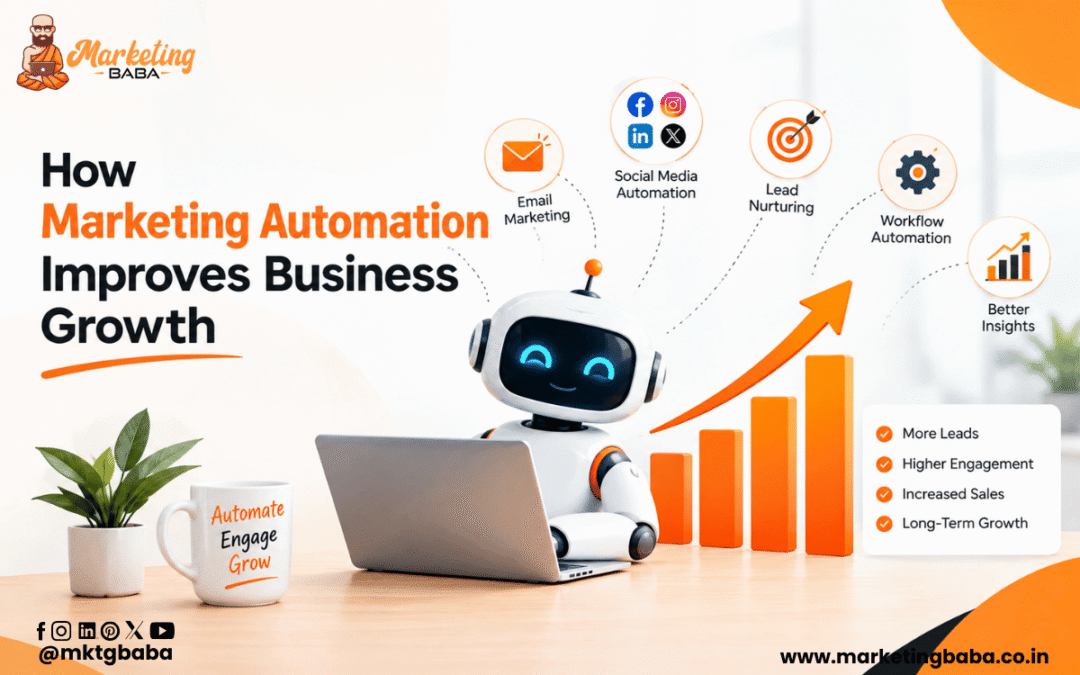
How Marketing Automation Improves Business Growth
How Marketing Automation Improves Business Growth is an important question for businesses that want to improve efficiency, generate better leads, and build stronger customer relationships. In today’s competitive market, businesses need more than traditional marketing methods to attract and retain customers. Marketing automation helps businesses streamline repetitive marketing activities, deliver timely communication, nurture leads, and make better use of customer data. By combining technology with marketing strategy, businesses can create more consistent campaigns while saving valuable time and resources.
What Is Marketing Automation?
Marketing automation refers to the use of software and technology to automate repetitive marketing tasks. These tasks can include email marketing, lead nurturing, customer segmentation, social media communication, campaign management, follow-ups, and reporting.
Instead of performing every activity manually, businesses can create automated workflows that respond to customer actions. For example, when someone fills out a form on a website, an automated system can send a confirmation email, add the lead to a database, and begin a relevant nurturing campaign.
Understanding How Marketing Automation Improves Business Growth starts with understanding how automation connects different parts of the marketing process. It helps businesses move prospects through the customer journey in a more organized and measurable way.
1. Saves Time and Improves Marketing Efficiency
One of the biggest advantages of automation is the ability to reduce repetitive manual work. Marketing teams often spend significant time sending emails, updating customer records, following up with leads, scheduling campaigns, and preparing reports.
Automation can handle many of these activities based on predefined rules and customer behavior. This allows marketing teams to focus more on strategy, creativity, content development, and customer experience.
This is one of the key reasons How Marketing Automation Improves Business Growth is becoming an important consideration for modern businesses. When employees spend less time on repetitive tasks, organizations can use their resources more efficiently.
For example, a business can schedule an entire email campaign in advance instead of manually sending every message. The system can automatically deliver different messages based on customer actions and engagement.
2. Helps Generate and Manage Better Leads
Lead generation is an important part of business growth. However, generating leads is only the beginning. Businesses also need an effective system to organize, qualify, and nurture those leads.
Marketing automation can capture leads from websites, landing pages, forms, advertisements, and other digital channels. Once a lead enters the system, automation can assign appropriate actions based on information such as interests, source, engagement, or previous interactions.
This creates a more organized lead management process.
When examining How Marketing Automation Improves Business Growth, lead management is one of the most important areas to consider. Businesses can reduce the chances of losing potential customers because of missed follow-ups or inconsistent communication.
3. Improves Lead Nurturing
Not every customer is ready to purchase immediately. Some prospects may need more information before making a decision.
Marketing automation helps businesses nurture these prospects through relevant and timely communication. For example, someone who downloads an industry guide could receive educational emails over several days or weeks.
The communication can gradually introduce the company, explain its services, answer common questions, and eventually encourage the prospect to contact the sales team.
This structured approach demonstrates How Marketing Automation Improves Business Growth by helping businesses maintain relationships with potential customers throughout the buying journey.
4. Creates Personalized Customer Experiences
Customers increasingly expect communication that is relevant to their needs. Sending the same message to every customer may not produce the best results.
Marketing automation allows businesses to segment audiences according to factors such as demographics, interests, purchase history, website behavior, location, and engagement.
For example, a business can create different campaigns for new leads, existing customers, inactive customers, and repeat buyers.
Personalization can make communication more meaningful and improve customer engagement.
This is another important part of How Marketing Automation Improves Business Growth because businesses can deliver more relevant experiences without manually managing every customer interaction.
5. Improves Customer Engagement
Consistent communication helps businesses stay connected with their audiences. Marketing automation makes it easier to communicate with customers at appropriate stages of their journey.
Businesses can automate welcome emails, educational content, product updates, reminders, offers, feedback requests, and follow-up messages.
The goal is not simply to send more messages. The goal is to deliver useful communication at the right time.
When businesses use automation strategically, they can maintain regular communication while reducing the workload on marketing teams.
Therefore, How Marketing Automation Improves Business Growth is closely connected with how effectively a company maintains customer engagement.
6. Makes Follow-Ups More Consistent
Following up with potential customers is essential, but manual follow-ups can easily be missed.
A prospect may contact a company today but receive a follow-up several days later, or not receive one at all. Automation can help create predefined follow-up sequences.
For example, after a customer submits an inquiry, the system can send an immediate acknowledgment. If the customer does not respond, another message can be sent after a specified period.
This does not replace personal communication when it is needed. Instead, it creates a reliable foundation for the sales and marketing teams.
Consistent follow-ups are an important factor in understanding How Marketing Automation Improves Business Growth because timely communication can help businesses manage opportunities more effectively.
7. Supports Better Customer Segmentation
Customer segmentation allows businesses to divide their audience into meaningful groups.
Marketing automation platforms can use customer data and behavior to create segments. These segments may include new visitors, qualified leads, existing customers, high-value customers, inactive customers, or people interested in a particular product.
Once audiences are segmented, businesses can develop campaigns specifically for each group.
This improves marketing relevance and helps businesses avoid unnecessary communication.
A well-planned segmentation strategy further explains How Marketing Automation Improves Business Growth by allowing companies to make their marketing efforts more targeted and organized.
8. Helps Align Marketing and Sales Teams
Marketing and sales teams need to work together to convert leads into customers.
Marketing automation can provide sales teams with useful information about lead activity. For example, sales representatives may be able to see whether a prospect opened emails, visited specific website pages, downloaded content, or interacted with a campaign.
This information can help sales teams prioritize conversations and understand the prospect’s interests.
Marketing automation can therefore create a stronger connection between marketing and sales.
This is an important consideration when exploring How Marketing Automation Improves Business Growth because better collaboration can create a smoother journey from lead generation to conversion.
9. Provides Valuable Marketing Data
Data plays an important role in modern marketing. Businesses need to understand which campaigns are working and where improvements are required.
Marketing automation systems can provide information about email opens, clicks, website activity, lead sources, campaign engagement, and other marketing metrics.
These insights help businesses evaluate campaign performance and identify areas for improvement.
Instead of relying entirely on assumptions, marketing teams can use measurable information to make decisions.
This demonstrates another aspect of How Marketing Automation Improves Business Growth: automation can transform customer interactions into useful marketing insights.
10. Improves Campaign Management
Managing multiple marketing campaigns manually can become complicated as a business grows.
A company may have separate campaigns for new leads, existing customers, product launches, seasonal promotions, and customer retention.
Marketing automation can help organize these campaigns through workflows and scheduling.
Businesses can plan communication in advance and establish rules for different customer actions.
As a result, teams can manage more campaigns without increasing manual workload at the same rate.
This scalability is one of the major ways How Marketing Automation Improves Business Growth for growing organizations.
11. Supports Customer Retention
Business growth is not only about acquiring new customers. Retaining existing customers is also important.
Marketing automation can help businesses maintain relationships after a purchase. Automated communication can include onboarding information, product education, feedback requests, service reminders, and relevant updates.
These interactions can keep customers informed and engaged.
Businesses can also create campaigns designed to reconnect with customers who have become inactive.
This explains How Marketing Automation Improves Business Growth from a customer retention perspective. Stronger ongoing communication can support long-term relationships.
12. Reduces Marketing Errors
Manual marketing processes can sometimes result in mistakes such as sending the wrong message, forgetting a follow-up, entering incorrect information, or missing an important campaign deadline.
Automation can reduce some of these errors by following predefined workflows.
Once a campaign has been properly configured and tested, the system can perform repetitive actions according to established rules.
However, automation still requires monitoring. Businesses should regularly review workflows, customer data, content, and campaign performance.
Effective quality control is an important part of How Marketing Automation Improves Business Growth because automation works best when supported by a well-planned strategy.
13. Helps Businesses Scale Their Marketing
A small business may initially manage customer communication manually. As the customer base increases, this approach can become difficult.
Marketing automation allows businesses to handle larger volumes of communication without requiring every task to be performed manually.
For example, a company can use automated workflows to communicate with thousands of leads while maintaining different journeys for different audience segments.
This scalability allows marketing teams to support business expansion more effectively.
For companies planning long-term expansion, How Marketing Automation Improves Business Growth becomes particularly relevant because automation can help marketing processes grow alongside the organization.
14. Improves Return on Marketing Efforts
Marketing automation can help businesses use their resources more effectively.
When repetitive tasks are automated, employees can spend more time on strategic activities. At the same time, data and analytics can help businesses identify campaigns that generate meaningful engagement.
Businesses can then adjust their marketing strategies based on performance.
The objective is not simply to automate everything. Businesses should automate appropriate processes while maintaining human involvement where creativity, judgment, and personal interaction are important.
This balanced approach is central to How Marketing Automation Improves Business Growth.
15. Enables Multi-Channel Marketing
Modern customers may interact with businesses through websites, email, social media, messaging platforms, advertisements, and other channels.
Managing these channels separately can create disconnected customer experiences.
Marketing automation can help businesses coordinate communication across multiple channels. Depending on the platform and integration, businesses can create workflows that connect customer activity across different touchpoints.
A coordinated strategy can make the customer journey more consistent.
This provides another practical example of How Marketing Automation Improves Business Growth by connecting marketing activities into a more structured system.
How Marketing Automation Can Help Different Businesses
Marketing automation is not limited to large corporations. Businesses of different sizes and industries can use automation according to their needs.
A small business can use automation for email campaigns, lead follow-ups, and customer communication. A growing company can use automation for segmentation, lead scoring, CRM integration, and campaign management.
An established organization may use advanced workflows, analytics, multi-channel campaigns, and customer lifecycle management.
The specific benefits depend on business objectives, customer behavior, available technology, and marketing processes.
Therefore, How Marketing Automation Improves Business Growth can look different for every organization. The most effective approach is to identify specific marketing challenges before selecting automation tools or workflows.
Best Practices for Marketing Automation
Businesses should follow a strategic approach when implementing marketing automation.
First, define clear objectives. Decide whether the primary goal is lead generation, customer engagement, retention, sales support, or campaign efficiency.
Second, understand the target audience. Automation becomes more effective when businesses know their customers’ needs, preferences, and behaviors.
Third, create useful content. Automated communication should provide value instead of overwhelming customers with promotional messages.
Fourth, segment the audience. Different customers may require different communication.
Fifth, monitor campaign performance. Review important metrics regularly and make adjustments.
Finally, keep human interaction in the process. Automation should support marketing teams rather than completely replace personal communication.
Following these practices helps businesses maximize the benefits described in How Marketing Automation Improves Business Growth.
Common Mistakes to Avoid
Although automation offers many benefits, poor implementation can reduce its effectiveness.
One common mistake is automating too much without considering the customer experience. Another is sending excessive messages. Businesses may also fail to update customer data or review old workflows.
Using generic communication for every customer is another potential problem.
Businesses should also avoid assuming that automation alone will solve marketing challenges. Successful marketing automation requires clear goals, quality content, accurate data, appropriate technology, and ongoing optimization.
Understanding these limitations provides a more realistic view of How Marketing Automation Improves Business Growth.
The Future of Marketing Automation
Marketing automation continues to develop as businesses adopt new technologies and data-driven marketing strategies.
Artificial intelligence, predictive analytics, customer data platforms, advanced personalization, and improved integrations are changing how businesses approach automated marketing.
Future marketing systems are likely to become more capable of analyzing customer behavior and supporting personalized customer journeys.
However, technology should always serve a clear business objective.
The long-term value of automation will depend not only on the tools businesses use but also on how effectively they combine technology, strategy, creativity, and customer understanding.
This makes How Marketing Automation Improves Business Growth an increasingly relevant topic for businesses planning their future marketing strategies.
Conclusion
How Marketing Automation Improves Business Growth can be understood through its impact on efficiency, lead management, customer engagement, personalization, follow-ups, data analysis, retention, and scalability.
Marketing automation allows businesses to streamline repetitive marketing activities while giving teams more time to focus on strategy and customer relationships. It can help businesses organize leads, nurture prospects, deliver relevant communication, measure campaign performance, and support marketing and sales collaboration.
However, successful automation requires more than software. Businesses need clear objectives, strong content, accurate customer data, effective segmentation, and continuous monitoring.
At Marketing Baba, we understand that every business has different marketing requirements. A successful marketing strategy should combine creativity, technology, planning, and execution. Marketing automation can become an important part of that strategy when it is implemented according to business goals and customer needs.
For businesses looking to improve their marketing processes, generate better leads, strengthen customer relationships, and build scalable marketing systems, understanding How Marketing Automation Improves Business Growth is a valuable starting point.
Marketing automation is not about removing the human side of marketing. It is about using technology to make marketing more organized, timely, measurable, and efficient. When the right processes are automated and the right strategy is applied, businesses can create stronger marketing operations that support sustainable growth.
-
Digital Marketing in 2026: What’s Working, What’s Dead, and What’s Next: Read More
-
9 Ultimate Lead Generation Secrets Revealed: Read More
-
8 Fresh Content Ideas to Engage Your Audience: Read More