
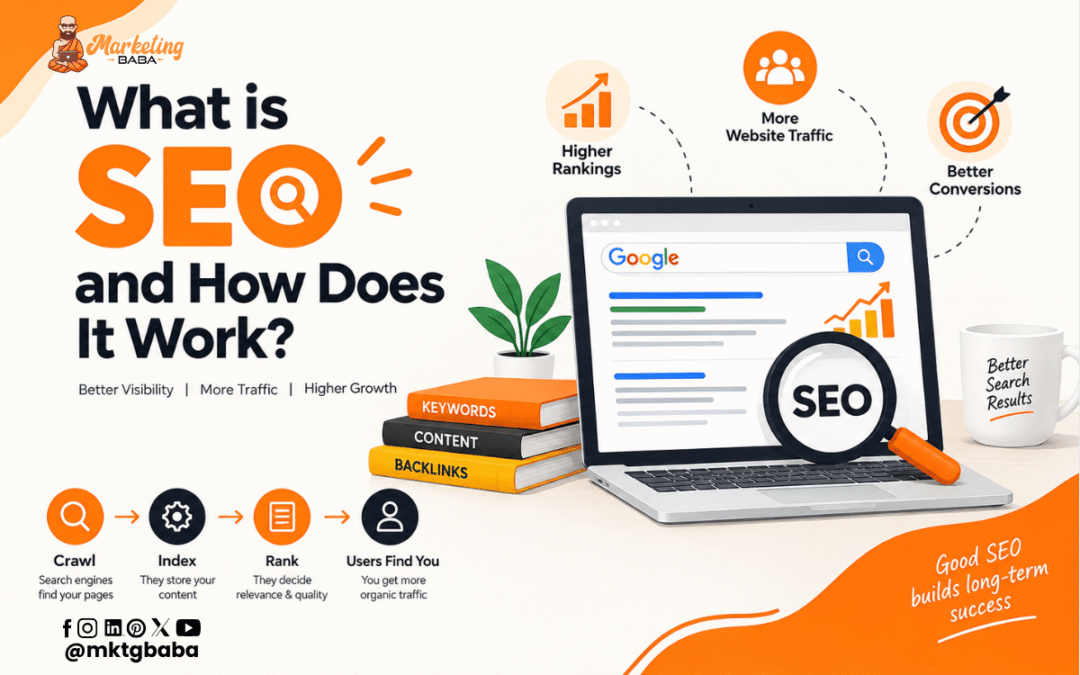
What is SEO and How Does It Work?
What is SEO and How Does It Work? Search Engine Optimization (SEO) is one of the most important digital marketing strategies for businesses that want to increase their online visibility, attract potential customers, and grow organically. In today’s competitive digital world, having a website is not enough. Your website must also appear in relevant search results when people look for products, services, or information related to your business.
At Marketing Baba, we help businesses strengthen their online presence through strategic digital marketing solutions, including search engine optimization, content marketing, website development, and online advertising. Understanding SEO can help businesses make better marketing decisions and build a strong foundation for long-term online growth.
This guide explains SEO, how it works, its major types, its benefits, and the practical steps businesses can take to improve their search engine rankings.
What Is SEO?
SEO stands for Search Engine Optimization. It is the process of improving a website so that search engines can understand its content and users can discover it more easily through relevant, unpaid search results.
When someone searches for a product, service, or question on Google, the search engine displays a list of pages that it considers relevant and useful. SEO helps websites improve their chances of appearing prominently in these results.
For example, if someone searches for a digital marketing agency in Ahmedabad, businesses with relevant content, useful service pages, strong website performance, and reliable online information may have better opportunities to appear in search results.
SEO focuses on several important areas, including:
- Keyword research: Identifying the words and phrases people use when searching online.
- On-page SEO: Optimizing website content, headings, titles, URLs, and internal links.
- Technical SEO: Helping search engines crawl, understand, and index website pages.
- Off-page SEO: Building website authority through relevant backlinks and brand mentions.
- Content optimization: Creating useful, relevant, and informative content that answers users’ questions.
- User experience: Making websites accessible, easy to navigate, and convenient to use.
SEO is not simply about adding keywords to a webpage. It involves improving the overall quality, relevance, accessibility, and usefulness of a website.
How Does SEO Work?
To understand how SEO works, it is important to understand how search engines discover and display webpages. Search engines use automated systems to find content, organize information, and determine which pages are most relevant to a user’s search.
SEO generally works through three main processes: crawling, indexing, and ranking.
1. Crawling
Crawling is the process through which search engines discover webpages using automated programs called crawlers or bots.
These crawlers follow links from one page to another and discover new or updated content. They may find pages through internal links, external links, and XML sitemaps.
For example, when you publish a new blog on your website, Google may discover it through a link from another page or through your sitemap.
To help search engines crawl your website effectively:
- Create a logical website structure.
- Add relevant internal links between pages.
- Maintain an updated XML sitemap.
- Avoid accidentally blocking important pages in robots.txt.
- Fix broken links and unnecessary redirect chains.
- Ensure important content is accessible to search engine crawlers.
If search engines cannot discover a page, that page may struggle to appear in search results.
2. Indexing
After discovering a webpage, a search engine may analyze its content and decide whether to store it in its index. This process is called indexing.
During this stage, search engines attempt to understand the page’s subject, content, images, and other relevant information.
However, not every crawled page is necessarily indexed. Duplicate content, technical issues, low-value pages, and certain indexing directives may affect whether a page is included.
Website owners can use Google Search Console to check indexing information and identify potential problems.
To improve indexability:
- Publish original and useful content.
- Use clear and descriptive page titles.
- Avoid unnecessary duplicate pages.
- Implement canonical tags correctly where appropriate.
- Check for accidental noindex directives.
- Provide relevant internal links to important pages.
Proper indexing helps search engines understand which pages on your website may be relevant to users’ searches.
3. Ranking
Ranking is the process of determining which results appear for a particular search query and in what order.
Search engines consider many signals when evaluating webpages. These may include relevance to the query, content quality, usability, page experience, location, and the context of the search.
For example, a person searching for beginner SEO guidance may need an educational article, while someone searching for SEO services may prefer a service provider’s website.
A successful SEO strategy focuses on matching the content to the user’s actual needs.
Important ranking-related considerations include:
- Content relevance and usefulness.
- Search intent and keyword alignment.
- Website accessibility and mobile usability.
- Page loading performance.
- Relevant, trustworthy backlinks.
- Clear website structure.
- Accurate and helpful information.
No SEO agency can guarantee a particular Google ranking because search engines continuously evaluate results and competitors also improve their websites.
What Are the Main Types of SEO?
SEO includes several interconnected practices. Businesses should use a balanced approach rather than relying on just one technique.
1. On-Page SEO
On-page SEO involves optimizing the content and HTML elements of individual webpages to help search engines and users understand them.
It includes keyword placement, title tags, meta descriptions, headings, internal links, image alt text, and content structure.
For example, a page about website development services should clearly explain the services offered, the intended audience, the development process, and the benefits of choosing the provider.
Important on-page SEO practices include:
- Include the primary keyword naturally in the title and relevant headings.
- Write a clear, descriptive title tag.
- Create a useful meta description that encourages relevant clicks.
- Organize content with logical H2 and H3 headings.
- Use descriptive URLs.
- Add relevant internal links.
- Optimize images and provide meaningful alt text.
- Answer the questions users are likely to have.
Avoid keyword stuffing, which means repeating keywords unnaturally in an attempt to manipulate rankings. High-quality content should read naturally and provide genuine value.
2. Off-Page SEO
Off-page SEO refers to activities outside your website that can help establish its reputation, authority, and visibility.
One important element is earning backlinks from other relevant and trustworthy websites. A backlink is a link from one website to another.
For example, a relevant industry publication linking to your business website may help users discover your brand and provide useful context about your website’s reputation.
Off-page SEO strategies include:
- Earning editorial backlinks through valuable content.
- Publishing expert articles on relevant websites.
- Building genuine business relationships.
- Encouraging authentic brand mentions.
- Participating in relevant industry discussions.
- Maintaining consistent and accurate business information.
The focus should be on quality and relevance rather than acquiring as many links as possible. Buying manipulative links or participating in link schemes can violate search engine spam policies.
3. Technical SEO
Technical SEO focuses on the technical aspects that help search engines access, crawl, interpret, and index a website.
Even excellent content may perform poorly if important pages cannot be accessed or the website has serious technical problems.
Key technical SEO elements include:
- Website crawlability and indexability.
- Mobile-friendly design.
- HTTPS security.
- XML sitemap configuration.
- Robots.txt configuration.
- Canonical tags.
- Structured data where appropriate.
- Website architecture.
- Page loading performance.
- Core Web Vitals.
For example, if a website has slow-loading pages, broken navigation, or accidental indexing restrictions, visitors may experience difficulties and search engines may have trouble accessing important content.
Regular technical audits help identify and resolve these problems.
4. Local SEO
Local SEO helps businesses improve their visibility in geographically relevant searches.
It is particularly useful for businesses that serve customers in specific cities, neighbourhoods, or service areas.
For example, a business offering marketing services in Ahmedabad may want to appear when potential customers search for a marketing agency in Ahmedabad.
Local SEO activities include:
- Optimizing your Google Business Profile.
- Maintaining accurate business contact information.
- Creating useful location-specific service pages.
- Collecting genuine customer reviews.
- Keeping business details consistent across relevant directories.
- Adding appropriate local business information to the website.
- Creating content relevant to the local audience.
Local SEO can help service providers, retailers, consultants, restaurants, and other location-based businesses connect with nearby customers.
5. Content SEO
Content SEO focuses on planning, creating, and improving content to meet users’ search needs.
Content may include blog posts, service pages, product descriptions, guides, frequently asked questions, case studies, and other helpful resources.
A strong content strategy starts by understanding what your audience wants to know. It then creates useful information that answers those questions accurately and clearly.
For example, a website development company could publish articles about website costs, WordPress websites, Shopify stores, website maintenance, and conversion optimization.
Content should be created for people first. Publishing many similar or low-value articles simply to target keywords is not a reliable long-term strategy.
Why Is Keyword Research Important in SEO?
Keyword research identifies the search terms people use when looking for information, products, or services.
It helps businesses understand customer needs and plan content around relevant topics.
Keywords can be grouped into several categories.
Informational keywords: People want to learn something.
Example: What is SEO and how does it work?
Navigational keywords: People want to find a particular brand or website.
Example: Marketing Baba website.
Commercial investigation keywords: People are comparing options before making a decision.
Example: Best SEO agency for small businesses.
Transactional keywords: People are ready to take an action or purchase a service.
Example: Hire an SEO company in Ahmedabad.
A useful keyword research process includes:
- Identify your products, services, and target audience.
- Brainstorm the questions customers frequently ask.
- Research relevant search terms using keyword research tools.
- Evaluate search intent, competition, and potential business value.
- Group related keywords into topic clusters.
- Assign primary topics to appropriate website pages.
- Monitor performance and refine your strategy.
Choosing keywords only because they have high search volume can be a mistake. Relevant keywords that attract qualified visitors may provide greater business value than broad terms that generate unrelated traffic.
How to Create an Effective SEO Strategy
A successful SEO strategy requires planning, consistent execution, and regular evaluation. The following steps can help businesses establish a practical SEO process.
Step 1: Conduct an SEO Audit
Start by reviewing the existing website to understand its strengths and weaknesses.
Check for technical errors, broken links, duplicate pages, missing titles, indexing problems, slow-loading pages, and weak content.
Tools such as Google Search Console, Google Analytics, and website auditing platforms can help identify issues and opportunities.
An SEO audit provides a starting point for prioritizing improvements.
Step 2: Understand Your Target Audience
Identify who your ideal customers are, what they need, and how they search for solutions.
A business targeting small companies may need different content from a business serving large enterprises.
Understanding your audience helps you select relevant keywords, develop useful pages, and communicate your value more effectively.
Step 3: Optimize Existing Pages
Review important service pages, product pages, and blog posts.
Make sure each page has a clear purpose, useful information, appropriate headings, descriptive metadata, and relevant internal links.
Update outdated information and improve pages that do not adequately answer users’ questions.
Avoid changing content merely to increase keyword frequency. Focus on clarity, relevance, and completeness.
Step 4: Publish Helpful Content
Develop a content calendar based on your audience’s questions and business goals.
Create articles that explain important topics, solve problems, compare options, and provide practical guidance.
For example, Marketing Baba can create content about SEO, social media marketing, Google Ads, website development, branding, and other online and offline marketing services.
Connect related articles to relevant service pages through natural internal links. This helps readers explore additional information and helps search engines understand the relationship between your pages.
Step 5: Improve Website Performance
Make your website convenient to use across desktop computers, tablets, and mobile phones.
Compress oversized images, reduce unnecessary scripts, use reliable hosting, and improve navigation where necessary.
Google’s Core Web Vitals measure aspects of loading performance, responsiveness, and visual stability. These metrics are useful for identifying user experience issues, although meeting particular scores alone does not guarantee high rankings.
Step 6: Build Website Authority
Promote your expertise through useful resources, genuine partnerships, industry contributions, and relevant digital PR activities.
Create original research, practical guides, or useful resources that other websites may naturally want to reference.
Avoid spammy link-building tactics that prioritize quantity over relevance and trustworthiness.
Step 7: Measure and Improve Results
SEO requires continuous monitoring because search trends, competitors, website content, and search engine systems change over time.
Track metrics such as:
- Organic clicks and impressions.
- Search queries and average positions.
- Organic landing-page traffic.
- Conversions and qualified leads.
- Engagement with important website pages.
- Indexed pages and technical errors.
- Revenue or other business outcomes attributable to organic search.
Use the findings to identify successful pages, resolve problems, and improve your strategy.
What Are the Benefits of SEO for Businesses?
SEO can deliver several advantages when implemented consistently and aligned with business objectives.
1. Increased Online Visibility
SEO helps relevant webpages become more discoverable in search results. Better visibility can introduce your business to people who may not know your brand.
2. More Relevant Website Traffic
Targeting appropriate search intent can attract visitors who are actively researching your products or services.
The goal is not simply to increase visitor numbers but to bring the right audience to the right pages.
3. Improved Brand Credibility
Useful content and a professional website can help businesses establish trust with potential customers.
Appearing in relevant search results may increase brand awareness, although rankings alone do not guarantee credibility.
4. Long-Term Marketing Value
Unlike some paid advertising campaigns, organic search traffic does not require payment for every click. However, SEO still requires investment in content, technical improvements, expertise, and maintenance.
Well-maintained pages can continue attracting visitors over time, but performance is never guaranteed.
5. Better User Experience
Many SEO improvements, such as clearer navigation, faster pages, descriptive headings, and accessible content, also make websites easier to use.
A better user experience can help visitors find information and complete important actions.
6. Support for Business Growth
SEO can contribute to enquiries, product sales, service bookings, and brand awareness when connected to an effective website and conversion strategy.
Businesses should evaluate SEO using meaningful outcomes rather than rankings alone.
How Long Does SEO Take to Show Results?
SEO is a long-term marketing activity, and results rarely happen overnight.
Some improvements may produce noticeable changes relatively quickly, while more competitive keywords and broader authority-building efforts can take considerably longer.
The timeline depends on several factors:
- Your website’s current condition and history.
- The competitiveness of your industry.
- The quality and relevance of your content.
- Technical SEO issues.
- Your website’s existing authority and backlink profile.
- The consistency of your optimization efforts.
- Search engine crawling and indexing.
New websites may need additional time to establish visibility. Established websites with strong content may see improvements sooner when addressing specific problems.
Instead of expecting immediate rankings, businesses should focus on steady improvements in relevant visibility, organic traffic, enquiries, and conversions.
Common SEO Mistakes to Avoid
Although SEO can create valuable opportunities, certain mistakes may limit performance or damage a website’s search visibility.
Keyword stuffing: Repeating the same keyword excessively makes content difficult to read and may violate spam policies.
Duplicate content: Publishing unnecessary copies of similar pages can confuse users and complicate search engine understanding.
Ignoring mobile users: A website that is difficult to navigate on mobile devices may provide a poor experience.
Buying spammy backlinks: Manipulative link schemes can create search engine policy risks.
Publishing low-quality content: Articles that provide little original value are unlikely to meet users’ needs effectively.
Ignoring technical problems: Broken links, incorrect canonical tags, and accidental noindex directives can affect important pages.
Expecting instant results: SEO takes ongoing work, testing, and adaptation.
Focusing only on rankings: High rankings are less valuable if they do not attract the right audience or contribute to business objectives.
Avoiding these mistakes helps establish a more sustainable SEO strategy.
Which SEO Tools Should You Use?
SEO tools help businesses understand website performance, research keywords, identify technical problems, and monitor progress.
Some useful tools include:
- Google Search Console: Monitors search performance, indexing information, and certain technical issues.
- Google Analytics: Helps measure website traffic and user interactions.
- Google Keyword Planner: Supports keyword research and provides advertising-oriented search estimates.
- Google PageSpeed Insights: Evaluates page performance and provides improvement recommendations.
- Screaming Frog SEO Spider: Helps audit website URLs, metadata, links, and technical elements.
- Ahrefs and Semrush: Offer features for keyword research, backlink analysis, competitor research, and SEO monitoring.
Not every business needs every tool. Start with the free tools that address your immediate requirements and add paid platforms when their additional features justify the cost.
How Marketing Baba Can Help With SEO
At Marketing Baba, we understand that businesses need more than a website to build a strong online presence. They need a strategy that connects their services with the people searching for them.
Our marketing approach combines search engine optimization with relevant content, website improvements, and other marketing activities to help businesses strengthen their visibility and reach their target audiences.
Our SEO-related support can include:
- Keyword research and planning.
- On-page SEO optimization.
- Technical SEO reviews.
- Content planning and optimization.
- Website structure and internal linking.
- Local SEO recommendations.
- Performance monitoring and improvement.
We also provide broader marketing solutions, including social media marketing, Google Ads, branding, graphic design, WordPress website development, Shopify website development, and offline marketing services.
Every business has different goals, competitors, and customer needs. A suitable SEO strategy should reflect these differences rather than rely on a one-size-fits-all approach.
To learn more about our services, visit Marketing Baba or explore our Search Engine Optimization services.
Conclusion
Understanding what SEO is and how it works is an important first step toward improving your business’s online presence. SEO helps search engines discover and understand your webpages while making it easier for potential customers to find relevant information through organic search.
An effective strategy combines keyword research, helpful content, on-page optimization, technical improvements, credible backlinks, and ongoing performance analysis. Each element contributes to building a website that serves both users and search engines.
SEO is not a one-time task or a guaranteed shortcut to the top of Google. It is a continuous process of understanding your audience, improving your website, and measuring meaningful results.
For businesses that want to grow online, investing in a well-planned SEO strategy can support long-term visibility, attract relevant visitors, and create opportunities for sustainable growth.
Ready to improve your website’s search visibility? Connect with Marketing Baba to explore SEO and integrated marketing solutions tailored to your business goals.
-
Digital Marketing in 2026: What’s Working, What’s Dead, and What’s Next: Read More
-
Best Marketing Consulting Services for Businesses: Read More
-
9 Ultimate Lead Generation Secrets Revealed: Read More
-
8 Fresh Content Ideas to Engage Your Audience: Read More
-
Best Marketing Consulting Services for Businesses: Read More